TL;DR
- Well drafted Service Agreement Clauses protect commercial relationships by providing legal certainty and reducing dispute risks.
- Canadian contract law enforces an overarching duty of good faith requiring honest performance and reasonable exercise of contractual discretion.
- Strong agreements require clear scope definitions, structured fee provisions, explicit intellectual property waivers, and enforceable liability caps.
- Individuals and businesses can create Service Agreement documents quickly by using a Ziji Legal Forms Service Agreement template tailored for commercial standards.
Introduction
Commercial entities across Canada rely heavily on formal agreements to establish business relationships, define service standards, and protect financial interests. A solid Service Agreement forms the foundation of any professional engagement by outlining exact responsibilities and remedies when performance issues arise. Without clear legal drafting, minor operational misunderstandings can escalate into expensive legal conflicts.
Canadian contract jurisprudence has established clear expectations regarding how commercial agreements are interpreted and enforced. The Supreme Court of Canada requires all contracting parties to act honestly and perform their contractual duties in good faith. Understanding these core legal principles enables business owners to draft agreements that withstand judicial scrutiny. Choosing to Create Service Agreement documents with well drafted terms protects long term business stability.
Why Poorly Written Clauses Lead to Disputes
The Lack of Objective Standards
Disputes frequently arise when contract terms rely on subjective criteria rather than verifiable metrics. Vague phrases such as prompt delivery, high quality, or reasonable efforts invite conflicting interpretations between service providers and clients. When expectations are not anchored to objective standards, assessing whether a party fulfilled its commitment becomes difficult.
Subjective drafting leaves performance open to debate, forcing courts to examine extrinsic evidence to determine intent. Establishing unambiguous metrics within every Service Agreement Canada ensures that both sides share identical expectations from day one. Objective standards eliminate guesswork and provide clear benchmarks for project success.
Internal Conflicts and Consistency Errors
Internal contradictions within a contract severely weaken its legal enforceability. Conflicts often occur when operational schedules contradict core contract clauses or when payment terms clash with liability provisions. Courts attempt to read commercial agreements as coherent wholes, but direct internal conflicts create severe ambiguity.
When clauses contradict each other, adjudicators must decide which term takes priority, creating unpredictable outcomes for both parties. Inconsistencies expose businesses to unexpected financial liabilities and lengthy litigation. Eliminating internal contradictions through careful clause review ensures that the entire contract functions smoothly.
What Makes a Clause Legally Strong?
Precision and Linguistic Clarity
Legal strength depends on precise language that clearly defines rights, duties, conditions, and exceptions. Strong clauses avoid unnecessary legal jargon, vague qualifiers, and ambiguous phrasing that could yield multiple interpretations. Straightforward drafting ensures that both contracting parties and courts understand the precise boundaries of performance.
Clear linguistic structure also minimizes reliance on interpretive rules that construe ambiguous terms against the drafter. By stating operational duties directly, businesses prevent counterparty misunderstandings. Precise phrasing forms the bedrock of an enforceable commercial contract.
Quantifiable and Measurable Obligations
Strong contractual provisions transform vague promises into quantifiable performance metrics. Incorporating specific parameters such as exact turnaround times, milestone completion dates, technical specifications, and defined fee schedules removes ambiguity. Measurable terms enable objective verification of compliance throughout the contract lifecycle.
When obligations are tied to clear metrics, assessing defaults becomes straightforward. Both parties can track progress against agreed benchmarks without relying on discretionary judgments. Quantifiable terms significantly reduce grounds for performance disputes.
Compliance with Federal and Public Standards
A contract clause must strictly comply with applicable federal statutes and public policy principles. Provisions that attempt to bypass statutory rights or violate public regulations are declared void by Canadian courts. Ensuring legislative compliance guarantees that contractual protections remain fully enforceable during judicial review.
Drafting teams must verify that standard provisions conform to governing statutory frameworks. For example, intellectual property transfers must align with federal statutory copyright provisions regarding creator rights. Aligning contract terms with public legal standards prevents clause invalidation during legal challenges.
How to Write Key Service Agreement Clauses Effectively
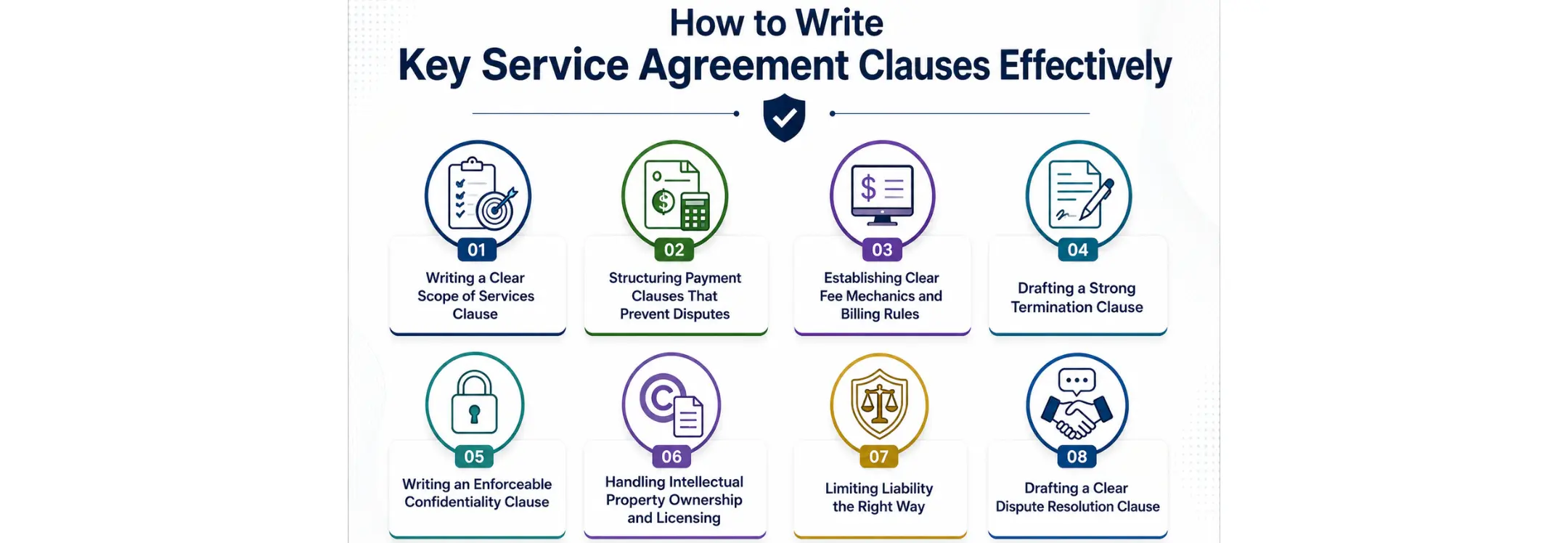
Writing a Clear Scope of Services Clause
The scope clause defines the precise operational commitments of the service provider. A well drafted scope section details all tangible deliverables, task parameters, operational boundaries, and completion timelines. Explicitly identifying what services are excluded is equally important to prevent scope creep and unpaid extra labor.
Unclear scope descriptions represent a primary cause of commercial service disputes. Outlining formal change order procedures within the scope section ensures proper compensation for additional requests. Clear scope boundaries maintain operational alignment between service providers and clients.
Structuring Payment Clauses That Prevent Disputes
Payment provisions must clearly detail fee structures, calculation formulas, invoicing schedules, and acceptable payment channels. Specifying payment grace periods, late interest rates, and work suspension rights for unpaid invoices protects cash flow. Clear provisions regarding deposit retainers and pre approved reimbursable expenses eliminate financial friction.
To prevent payment disputes, fee structures should link directly to clear project milestones or recurring calendar dates. Clauses should clearly outline tax obligations and billing dispute procedures, requiring partial payment of undisputed amounts during review. Transparent payment mechanics foster stable commercial relationships.
Establishing Clear Fee Mechanics and Billing Rules
Beyond basic payment schedules, contracts must define precise rules for fee adjustments and disputed invoices. Specifying currency, net payment terms, and required billing documentation prevents administrative delays. Clear terms should outline the exact process for notifying the provider of billing errors within a set timeframe.
Establishing explicit rules for fee increases during contract renewals prevents sudden commercial disagreements. Setting reasonable interest rates on overdue balances encourages timely settlement while respecting statutory interest limits. Clear billing rules eliminate administrative friction and protect predictable revenue streams.
Drafting a Strong Termination Clause
Termination provisions must establish precise mechanisms for ending an agreement for convenience or cause. In Canadian contract law, exercising termination rights is subject to the fundamental duty of honest performance established in Callow v Zollinger. Contracting parties must not actively deceive or mislead each other when exercising termination rights.
Drafting clear notice periods, cure opportunities for default, and explicit post termination obligations prevents wrongful termination claims. Specifying how outstanding fees and work transition duties are handled minimizes operational disruption. Well structured termination terms allow parties to exit agreements smoothly while mitigating litigation risk.
Writing an Enforceable Confidentiality Clause
A comprehensive confidentiality clause must define protected proprietary information, handling standards, authorized disclosures, and duration obligations. Drafting clear exceptions for information that is publicly known, independently developed, or legally compelled prevents overbroad restrictions. Establishing concrete security measures ensures that sensitive commercial data remains protected.
Enforceable confidentiality terms balance proprietary protection with reasonable operational flexibility. Specifying mandatory return or destruction of confidential materials upon agreement termination provides clear closure. Robust confidentiality provisions protect vital commercial assets throughout and beyond the contractual relationship.
Handling Intellectual Property Ownership and Licensing
Intellectual property clauses must explicitly declare the ownership status of all work product generated during contract performance. Under the Canadian Copyright Act, assigning economic copyright ownership does not automatically waive moral rights held by the original author. Therefore, an effective clause must include an express waiver of moral rights alongside the assignment of intellectual property.
Without an explicit waiver of moral rights, creators retain statutory rights to restrain modifications or demand attribution. Incorporating clear assignment language and moral rights waivers ensures complete commercial utility for the client. Explicit licensing terms for pre existing background intellectual property further protect both parties from ownership disputes.
Limiting Liability the Right Way
Limitation of liability provisions manage commercial exposure by capping financial damages and excluding recovery for indirect loss. To maintain legal enforceability under Canadian law, liability caps must be reasonable and proportional to the underlying contract value. Clauses that attempt total exculpation for gross negligence or intentional misconduct are routinely invalidated by courts.
Drafting effective limitation provisions requires separate sub-clauses for direct damage caps and indirect damage exclusions. Clearly defining exceptions to liability limits, such as breaches of confidentiality or indemnification obligations, preserves balanced risk allocation. Well drafted liability limitations shield businesses from catastrophic financial exposure.
Drafting a Clear Dispute Resolution Clause
Dispute resolution provisions set out structured administrative procedures for settling conflicts before resorting to court litigation. Implementing a tiered dispute framework involving mandatory negotiation, formal mediation, and binding arbitration controls legal expenses. Clear procedural guidelines ensure efficient conflict management without prematurely severing commercial ties.
The dispute clause must designate the governing arbitration rules, physical hearing location, and official language of proceedings. Establishing realistic timelines for each stage of dispute resolution prevents deliberate delays by non performing parties. Structured dispute mechanisms maintain business stability during commercial disagreements.
The Impact of Governing Law and Jurisdiction
Governing law and jurisdiction provisions establish the legal framework and forum governing agreement interpretation. Governing law clauses specify the laws used to construe contractual rights, while jurisdiction clauses determine which court system holds authority over disputes. Aligning governing law with primary commercial operations ensures legal predictability and reduces jurisdictional litigation.
Choosing appropriate forum selection clauses prevents costly jurisdictional challenges during contract enforcement. Parties must ensure that chosen forums possess a logical connection to the contracting entities or service performance location. Proper legal framework selection ensures smooth enforceability across commercial jurisdictions.
Incorporating Force Majeure and Excused Performance
Force majeure clauses excuse performance failures resulting from severe, unforeseeable events beyond reasonable control. Strong provisions define qualifying events such as natural disasters, war, or unexpected regulatory restrictions, while explicitly excluding general economic downturns. Requiring prompt written notification and reasonable efforts to mitigate prevents improper reliance on excused performance protections.
The clause must specify maximum performance suspension periods before either party gains the right to terminate the agreement. Defining financial adjustment mechanics during force majeure events prevents ongoing fee accruals during operational halts. Thoughtful force majeure drafting balances risk allocation during catastrophic occurrences.
Red Flags That Make Clauses Weak or Unenforceable
Several drafting defects compromise the enforceability of Service Agreement Clauses in Canadian courts. Unilateral discretionary powers that grant arbitrary control violate the judicial standard established in Wastech Services Ltd v Greater Vancouver Sewerage, which requires discretionary powers to be exercised reasonably and consistently with contractual purpose. Unreasonable restrictive covenants, punitive damages disguised as liquidated damages, and missing moral rights waivers also weaken contract validity.
Overly broad exculpatory clauses that attempt to eliminate all corporate liability represent another major enforceability red flag. Contract terms that conflict with mandatory statutory protections or public order rules are similarly struck down. Identifying and rectifying these drafting flaws before execution safeguards contract integrity.
How to Review Your Service Agreement Before Signing
Consistency Checklist for a Quick Audit
Performing a thorough contract audit prior to signature prevents future legal disputes. Reviewers must verify that defined terms are used consistently, defined capitalized terms match across all sections, and payment schedules align with deliverable milestones. Confirming that termination provisions, liability limits, and dispute timelines work harmoniously ensures complete document integration.
Auditors should confirm that all attachments, schedules, and referenced exhibits are fully attached and accurately incorporated. Checking cross references between clauses prevents conflicting legal interpretations. A systematic pre execution audit ensures that the final agreement reflects true commercial intent.
Creating a Service Agreement with Ziji Legal Forms
1. Choose Template
2. Add Party Details
Input complete corporate names, legal addresses, and authorized representative details for both contracting parties.
3. Add Payment Details
Define fee structures, billing intervals, accepted payment methods, and applicable late payment terms clearly.
4. Add Term Details
Set agreement start dates, performance milestones, renewal options, and required termination notice periods accurately.
5. Preview
Review the complete customized contract draft to verify consistency, accuracy, and legal enforceability before signing.
Conclusion
Drafting strong commercial contracts requires balancing operational clarity with established Canadian legal standards. Incorporating precise scope provisions, structured fee schedules, and explicit moral rights waivers ensures long term enforceability. Adhering to good faith doctrines and honest performance obligations protects commercial relationships from costly litigation. Utilizing an Online Service Agreement template simplifies drafting while maintaining professional compliance across all key provisions. Investing time in careful contract creation secures predictable outcomes and protects business growth.
Service Agreement FAQs
1. How does a Service Agreement protect both parties?
It clearly documents the services, payment terms, responsibilities, and other expectations, reducing the risk of misunderstandings.
2. Who benefits from a Service Agreement?
Both clients and independent contractors benefit from having a written agreement that defines their rights and obligations.
3. Is a Service Agreement the same as an Employment Agreement?
No. Service Agreements are intended for independent contractors, while Employment Agreements govern employer-employee relationships.
4. Should every service project have a written agreement?
Yes. A written agreement helps minimize disputes and provides stronger legal protection if issues arise.
5. Who owns the intellectual property created under a Service Agreement?
Ownership depends on the terms of the agreement. The contract should clearly state whether the contractor or the client owns any intellectual property created during the project.
6. What jurisdictions are covered by the Ziji Legal Forms Service Agreement?
The Ziji Legal Forms Service Agreement is suitable for use throughout all supported provinces and territories in Canada.
Author
Mandar Sonavane
|
Legal Content Writer at Ziji Legal Forms Inc.
Symbiosis International University
Mandar is a legal content writer specializing in the development of clear, practical, and easy-to-understand legal resources. With a strong focus on legal research, content creation, and plain-language writing, he works closely with our legal professionals to ensure that legal documents and educational materials are accurate, accessible, and user-friendly. At Ziji Legal Forms Inc., Mandar is responsible for researching legal topics, drafting and reviewing content, and helping transform complex legal concepts into straightforward guidance that empowers individuals and businesses to confidently navigate their legal needs.
Reviewed By
Histon Shek
|
General Counsel and Co-Founder at Ziji Legal Forms Inc.
University of Alberta
Histon Shek was called to the Alberta Bar in 2006. He holds a BA in Sociology and Philosophy and an LLB from the University of Alberta. As co-founder of Ziji Legal Forms Inc., he focuses on making legal documents accessible and affordable, overseeing legal integrity and content development.









 Canada
 United States