Employment Contract FAQs
What else can an employment contract be called?
An employment contract can also be referred to as follows: contract of employment, employment agreement, or employee contract.
What is an employment contract?
An employment contract is an agreement between the employer and the employee that governs the terms of the employment.
Why is an employment contract needed and when should you use it?
Having an employment contract ensures both the employer and employee know their rights and obligations in the working relationship. Having all the terms of the employment in writing ensures there is no ambiguity and disagreement down the road for both parties.
An employment contract should be used by business owners, human resource managers or recruiters that are hiring employees for their business. Please note, a service agreement or independent contractor agreement should be used instead of an employment contract if an independent contractor is being hired to perform certain services for the company.
What is a probation period?
The probation period is usually the first 3 to 6 months of employment where the employee can be terminated without just cause. Meaning the employee can be terminated without any reason as long as the employee was not terminated for illegal reasons. (Some examples of illegal terminations include but not limited to: terminating an employee based on their sex, race, colour, creed, religion, national origin, pregnancy, age, disability etc.)
The probation period is used as an evaluation period to ensure the employee is a good fit with the employer’s work place. Once the probation period is over, the employer would need just cause, a valid reason, to terminate the employee or the employee would have to be provided notice and/or severance payment in lieu of notice. The termination notice varies across the jurisdiction based on the number of months the employee has been employed, and the employer should consult with employment standards to ensure the proper notice is given upon termination.
Why is a confidentiality clause needed in an employment contract?
Much of a company’s business information is vital to the success of the company long term. Information dealing with sales data, marketing strategies, product design and secret recipes and ingredients are crucial to the company’s competitive edge. As such, these confidential information needs to be protected so an employee cannot share this information with competitors or other third parties. Having a confidentiality clause prohibits the employee from revealing sensitive information during and after the employee’s employment. Typical confidentiality clause will be in effect during the full term of the employment and lasting for a year or two after the termination of the employment, but it can also last indefinitely for more proprietary designs or secret recipes. For example, Kentucky Fried Chicken’s secret seasoning ingredients.
Why is a non-compete clause needed in an employment contract?
A non-compete clause prohibits the employee from working for the employer’s competitor in the sector for a brief period after the employee’s termination. It can also limit the geographic location where the employee could seek similar work. The non-compete clause has a similar goal as the confidentiality clause as they are often used together to prevent the employee from sharing sensitive business information to the employer’s competitors. However, most non-compete clause are very short in duration and cannot last indefinitely because courts will not favor non-compete clauses that will prevent an employee from seeking and finding meaningful work in the same sector.
What topics are covered in a typical employment contract?
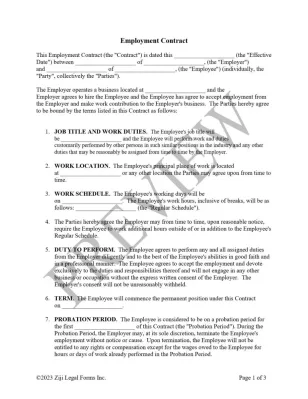
An employment contract should cover the following basis of the employment relationship:
- Probation period: Is there a probation period for the employee and if so, how long is the said probation period.
- Employee Duties: Outlining the type of work and responsibilities the employees will be performing on the job.
- Employment Terms: Will the work be full time or part time and whether the position is temporary or permanent. Basically outlining how long term of the employment will be for the position.
- Work schedule: Listing which days of the week the employee will be working and specifying the employee’s hours of work and work location.
- Remuneration: Listing how much the employee will be paid, and how the employee will be paid. For example, whether the employee will receive hourly pay, a flat salary, paid by commission, or a combination thereof.
- Employee benefits: Listing what other benefits the employee will receive in addition to the salary, such as health and dental insurance, paid vacation, paid sick leave, pension plan, professional development and upgrade courses, employee discounts etc.
- Confidentiality clause: A clause that prevents the employee from revealing sensitive business information about the employer’s business.
- Non-compete clause: A clause that prevents the employee from using information from the employer and then working for a competing business after leaving the job. It also prevents the employee from inducing the employer’s other employees to leave their job to work for a third party.
How does an employee differ from an independent contractor?
An employee typically works under the employer’s direct supervision, following set hours, using the employer’s tools, and receiving benefits such as vacation or health insurance. An independent contractor, by contrast, runs their own business, decides how and when to complete tasks, and is generally not entitled to employee benefits. The distinction matters because it affects tax treatment, legal protections, and the type of contract used.
Can the terms of an employment contract be updated after signing?
Yes, but both sides must agree to any changes. Adjustments to an employment contract should be documented in writing and signed by both the employer and the employee. Relying on verbal changes is risky, as they can be easily misunderstood or disputed later.
Is a written employment contract mandatory?
In some regions, a verbal agreement may be legally valid, but having the terms in writing is always safer. A written contract clearly outlines the expectations and responsibilities of both parties and can help resolve disputes if they arise.
What are the consequences of breaking an employment contract?
If one party fails to fulfill the terms in the contract, it may be considered a breach. Depending on the situation, the other party might seek damages, enforce specific clauses, or end the agreement. The remedies available will depend on the severity of the breach and the governing laws.
Do employment contracts need to follow local labor regulations?
Absolutely. No matter what is written in the agreement, it cannot override employment laws in the place where the employee works. If a term violates minimum wage, overtime, or leave requirements set by law, that clause will usually be unenforceable.
What jurisdictions can use our employment contract?
You can use our template to create a legal and valid employment contract for the following jurisdictions:
|
Alberta
British Columbia
Manitoba
New Brunswick
Newfoundland and Labrador
Northwest Territories
Nova Scotia
Nunavat
Prince Edward Island
Saskatchewan
Yukon |
AB
BC
MB
NB
NL
NT
NS
NU
PE
SK
YT |







 Canada
 United States