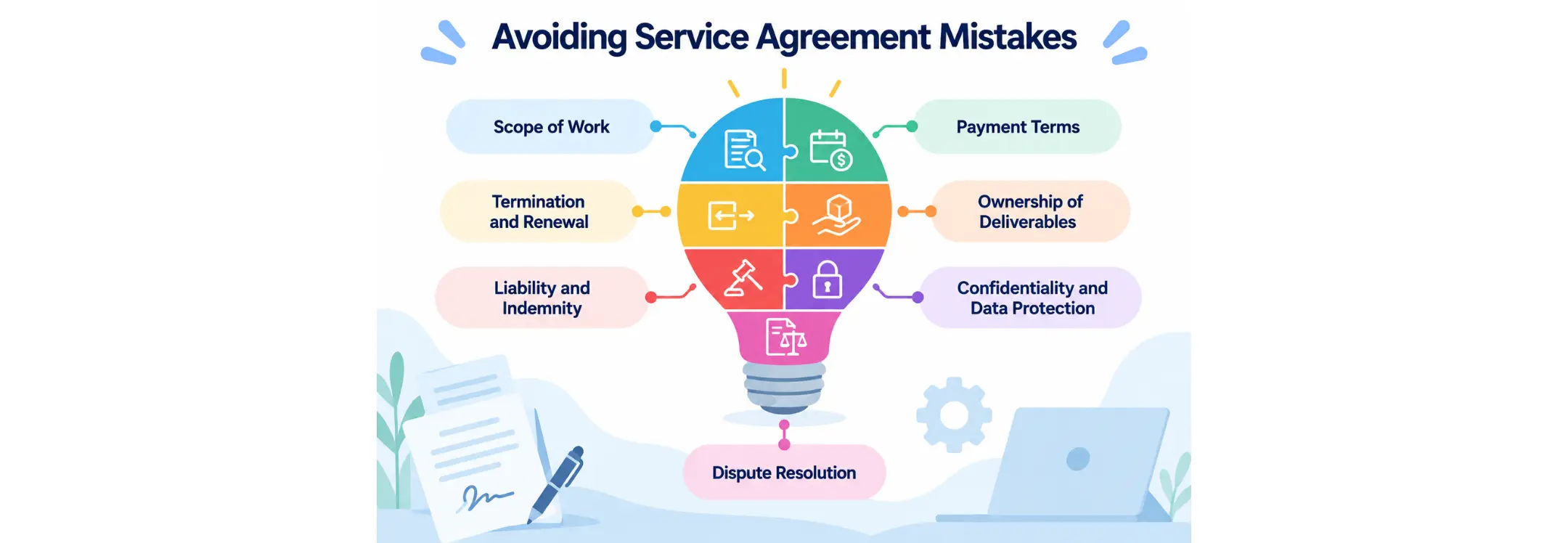
TL;DR- Define the scope of work with absolute precision to prevent scope creep and ensure both parties understand every deliverable.
- Detail payment schedules and interest rates to remain compliant with the federal Interest Act and the Criminal Code of Canada.
- Incorporate clear termination and renewal provisions to manage notice periods and the specific risks associated with dependent contractor status.
- Assign intellectual property rights explicitly in writing because independent contractors retain ownership of their creations by default under Canadian law.
- Establish liability limits and indemnity clauses to allocate risks fairly and protect against third party claims or unforeseen damages.
- Include robust data protection and confidentiality terms that satisfy the requirements of the Personal Information Protection and Electronic Documents Act.
- Specify dispute resolution mechanisms and provincial jurisdictions to avoid the excessive costs of litigating across different Canadian regions.
- You can use Service Agreement Templates provides by Ziji Legal Forms to easily create customized service agreements
Introduction: Why Service Agreement Mistakes Matter
The creation of a service agreement is a fundamental step in establishing a professional and legally enforceable relationship between a provider and a client in the Canadian market. A service agreement is a document that describes the terms and conditions for providing specified services between a business and a customer. Under the principles of Canadian contract law, such agreements are binding when they fulfill the requirements of an offer, acceptance, and consideration. A contract is defined as a legally recognized agreement between two or more persons which gives rise to an obligation that may be enforced in a court of law.
Mistakes in these documents often stem from the use of vague language or the failure to account for federal and provincial statutes. When terms are unclear, the risk of a legal dispute increases significantly. Canadian courts often apply the doctrine of contra proferentem, which means any ambiguity in a contract is interpreted against the interests of the party that drafted it. Furthermore, service agreements must be distinguished from employment contracts. A service agreement is used when a client hires an independent contractor, which does not create an employer and employee relationship.
The legal landscape in Canada has evolved to demand a high degree of honesty and good faith in the performance of contracts. The Supreme Court of Canada has clarified that parties have a duty to act honestly toward one another and not to mislead each other regarding the performance of the contract. Failing to understand these obligations can lead to claims of breach of contract even if a party follows the literal words of a poorly drafted agreement. Professional service contracts act as a roadmap for governance, issue resolution, and performance measurement.
A well researched agreement protects business assets, ensures payment, and manages liability. Without these protections, a business may find itself vulnerable to financial losses or legal challenges that could have been easily avoided with a comprehensive template. Because Canadian law differs from that of the United States, specifically regarding intellectual property and interest rates, it is vital to use documents tailored for the Canadian context. This report identifies the most common errors made by businesses and provides guidance on how to secure a professional relationship using reliable legal forms.
Mistake 1: Failing to Define Scope of Work Clearly
A major issue in Canadian service agreements is the use of vague or ambiguous language to describe the services being provided. This lack of clarity often leads to misinterpretation in contract law, where both parties have conflicting understandings of the same provision. The scope of work should define exactly what is being built or performed and who is responsible for each task. Without a precise description, the parties lose the ability to examine performance and results against a clear scorecard.
How Vague Deliverables Lead to Scope Creep
Scope creep is the gradual expansion of project requirements beyond what was originally agreed upon without a corresponding increase in fees. In the Canadian context, this often occurs when a service description is too broad or fails to list specific inclusions and exclusions. When the boundaries of a project are not defined, a provider may end up performing extra work to satisfy a client, which can gut profits and strain resources.
Many businesses assume that a general description covers all tasks reasonably inferable from the work, but this can widen the scope in a way that is difficult to manage. For example, a web designer might agree to create a website but fails to specify the number of revisions included. The client may then demand unlimited changes, leading to a situation where the work exceeds the original budget. Clear milestones and final deliverables ensure that both parties know when obligations are fulfilled.
Real-World Impact
The real world impact of a vague scope is often seen in litigation over unpaid invoices or claims of incomplete work. Canadian courts have held that a refusal by a contractor to complete minor deficiencies can be viewed as a fundamental breach of contract. In cases where the contract requires a fixed price for changes, the contractor cannot wait until the end of a job to claim impact costs from multiple small changes.
If the scope is unclear or changes mid project, the complications can lead to delays and increased liability for organizations. In the construction industry, for instance, a vague subcontract can lead to work that falls short of expectations or results in disputes between general contractors and their suppliers. The failure to document changes through written change orders is a frequent cause of conflict in Canadian commercial projects.
How to Prevent This Mistake
To prevent scope creep, businesses should undertake a joint planning exercise to define the service relationship before signing the contract. The agreement must include a detailed service inventory or a purpose statement that clarifies the project goals. It is essential to be clear and specific when describing the frequency of services and the exact nature of the deliverables.
Adding a clause that requires all amendments and change orders to be in writing and signed by both parties creates a clear paper trail. This ensures that any new tasks are recognized as additions to the original scope and are compensated accordingly. For complex projects, businesses should use tiered service models and clearly define the relative roles and accountabilities of each party.
Mistake 2: Leaving Out Payment Terms and Schedule
The financial foundation of a service agreement requires explicit details regarding how and when a provider will be compensated. Leaving out payment terms is a critical mistake that can lead to cash flow problems and difficulty in collecting debts. A comprehensive agreement must specify the amount to be paid, the payment structure, and the due date for all invoices.
Why Payment Terms Matter
Clear payment terms provide a legally enforceable guarantee that a contractor will be paid for their services. In Canada, payment assurance is a vital concern for small business owners and freelancers who operate as independent contractors. By detailing the compensation rates and the basis for the fee structure, the parties minimize the risk of unfounded claims about the nature of the financial arrangement.
Furthermore, payment terms help establish whether the debt is unsecured or tied to specific collateral. While many service agreements involve unsecured debt, some businesses may use a promissory note to formalize a promise to pay a certain sum. A promissory note is a legal financial instrument that is often shorter and less formal than a full loan agreement. It is governed by the federal Bills of Exchange Act in Canada and serves as proof of an outstanding debt.
Financial Impact on Businesses
The financial impact of missing payment terms can be significant due to the federal Interest Act. If a contract is silent on the rate of interest for late payments, the default rate in Canada is only five percent per annum. This rate applies whenever interest is payable by agreement but no specific rate is fixed. If a business wishes to charge a higher rate for overdue accounts, that rate must be clearly stipulated in the written contract.
There are also strict limits on the maximum interest rates allowed in Canada. The Criminal Code makes it a criminal offense to charge an effective annual rate of interest greater than sixty percent. This calculation includes various fees and administrative charges, so businesses must ensure their late payment penalties do not inadvertently exceed this limit. In some provinces, courts have the power to void borrowing costs if they are found to be excessive or unconscionable.
Essential Payment Elements
A robust service agreement should include several key payment elements to protect the provider. First, it should specify the payment structure, whether it is a fixed fee, an hourly rate, or a milestone based arrangement. Second, the agreement must outline the billing schedule and specify the exact day a payment becomes overdue.
Third, the document should detail how work related expenses will be handled, including whether they are non-reimbursable or require pre-approval. Fourth, it is beneficial to include terms for an initial deposit or a retainer to secure the commitment of the client. Finally, if the client defaults, the agreement should specify the consequences and the remedies available to the provider.
Mistake 3: Ignoring Termination and Renewal Clauses
The inability to exit a contract cleanly is a major source of litigation in Canada. Many businesses fail to include detailed termination provisions, assuming that the relationship will continue indefinitely. However, without a clear termination clause, the parties may be subject to common law principles that require reasonable notice before ending the relationship.
Risks of Absent Termination Provisions
The risks of absent termination provisions include the possibility of being sued for wrongful dismissal or breach of contract. In Canada, courts may award common law reasonable notice to non employees if they are found to be dependent contractors. A dependent contractor is someone who works exclusively for one business and relies on that income for their livelihood.
Courts have awarded notice periods of up to twenty four months or more in exceptional cases involving long service workers. Even if a contract allows for termination at any time, employers must exercise that right in good faith. An abrupt or bad faith termination can lead to liability even if the contract literally permits it. Failing to specify a notice period in the agreement leaves the business vulnerable to the unpredictable decisions of a judge.
What Balanced Termination Looks Like
A balanced termination clause should clearly state the conditions under which either party can end the agreement. It is common to include a provision for termination for cause, such as a material breach of the contract or bankruptcy. The agreement should also allow for termination for convenience, provided a specific notice period is given, such as thirty or sixty days.
The clause must be explicit about the payment obligations upon termination. The provider should be entitled to payment for all work performed and accepted up to the date of termination. Additionally, the agreement should address the renewal of the contract, specifying whether it ends on a certain date or continues automatically unless cancelled. Including an amendments clause that requires renewals to be in writing helps avoid the confusion of a contract that has technically expired but where work continues.
Mistake 4: Not Addressing Ownership of Deliverables
Intellectual property is often the primary reason for a service engagement, yet many agreements fail to specify who owns the final work. In Canada, copyright law is statutory and follows specific rules for authors and owners. A common mistake is the assumption that paying for a service automatically transfers ownership to the client.
Intellectual Property Ownership Disputes
Under the Copyright Act of Canada, the author of a work is generally the first owner of the copyright. While there is an exception for employees who create work during their employment, this does not apply to independent contractors. Unless there is a written agreement to the contrary, the independent contractor retains ownership of the copyright in the works they create for a client.
This can lead to significant disputes over the right to reproduce, modify, or sell the deliverables. Without an express provision for the assignment of rights, the client may only have a limited right to use the work for its intended purpose. In some cases, an employer may lose copyright protection even if an employee develops a competing product, if it was not created in the course of their assigned duties.
Different Ownership Models
Businesses should choose an ownership model that fits their needs. The most common approach is an assignment of all intellectual property rights to the client upon full payment. A Proprietary Information and Inventions Assignment Agreement is often used to ensure that any inventions or improvements made during the work are owned by the company.
Another model is for the provider to retain ownership but grant the client a perpetual, royalty free license to use the work. This is particularly useful if the contractor uses background information or pre existing tools that they wish to keep for other clients. Regardless of the model, a service agreement in Canada should also include a waiver of moral rights. Moral rights include the author's right to the integrity of the work and cannot be assigned; they can only be waived in writing.
Mistake 5: Overlooking Liability and Indemnity Clauses
Liability and indemnity clauses are essential for allocating risk and protecting a business from the costs of litigation. Many small businesses overlook these sections because they seem overly technical, but they are critical for long term security. In Canada, the law requires individuals and entities to take reasonable care to avoid acts or omissions that could foreseeably injure others.
Why Liability Protection Matters
Liability protection matters because it limits the financial exposure of a party in the event of an error or omission. A limitation of liability clause can cap the damages a provider must pay at a certain amount, such as the total value of the contract. This prevents a single mistake from causing the total financial ruin of a service provider.
Courts generally look at the bargain made between the parties to determine their objective intent to be bound by these limitations. Without an express clause, a party could be liable for all damages that are a reasonably foreseeable result of their negligence. Liability caps provide financial predictability and help businesses manage their insurance requirements.
Common Liability Structures
Common liability structures include mutual, unilateral, and capped indemnities. An indemnity is a legally binding promise where one party takes responsibility for losses or damages another party may suffer. For instance, a subcontractor might indemnify a general contractor for any damages caused by their negligent work.
Mutual indemnity clauses are used to ensure that each party is responsible for their own actions and protects the other from resulting third party claims. It is standard to include exclusions for gross negligence or willful misconduct, ensuring that parties remain liable for intentional wrongdoing. These clauses often include specific procedures for notifying the other party of a claim and managing the legal defense.
Mistake 6: Missing Confidentiality or Data Protection Clauses
Protecting sensitive business information and personal data is a legal requirement in the modern digital economy. Missing these clauses can lead to violations of privacy laws and the loss of client trust. In Canada, the Personal Information Protection and Electronic Documents Act sets the ground rules for how organizations collect, use, and disclose personal information.
Protecting Client Trust and Compliance
Confidentiality clauses ensure that a contractor does not share sensitive client information with third parties. This is especially important when a contractor is hired to handle trade secrets or proprietary business data. Non disclosure agreements are enforceable in Canada as long as they are reasonable and specific to the business needs.
Data protection clauses are required whenever personal information is transferred to a third party for processing. Under PIPEDA, an organization remains responsible for the data in its possession even when it is being handled by a service provider. The law requires that a written agreement be in place to ensure a comparable level of protection for that information.
Example Scenarios Requiring Protection
Scenarios requiring these protections include information technology services, payroll processing, and marketing activities that involve customer lists. If a contractor collects personal information on behalf of a client, all intellectual property rights in that data should vest in the client immediately upon collection.
Businesses must follow the ten fair information principles of PIPEDA, including accountability, identifying purposes, and safeguards. Organizations should appoint a privacy officer and implement security measures appropriate to the sensitivity of the data. Using plain and simple language in privacy policies is also recommended to ensure that consent obtained from individuals is meaningful and valid.
Mistake 7: Not Adding Dispute Resolution and Jurisdiction Clauses
Disputes can be exceptionally costly if there is no pre agreed method for resolving them. Failing to specify the governing law and the forum for legal proceedings can lead to confusion and jurisdictional battles. In Canada, parties are free to choose the laws of a specific province or territory to govern their agreement.
Why Dispute Resolution Matters
Dispute resolution clauses provide a mechanism for governance and issue resolution before a situation escalates to the court system. Litigation through the courts is a traditional option, but it can be a slow and expensive process. Canadian courts will generally uphold a forum selection clause unless there are strong public policy reasons to override it.Specifying a jurisdiction ensures that a business is not forced to defend itself in a distant province where the laws may be different or the legal costs are higher. This is particularly important for remote services where the provider and the client are located in different parts of Canada. Clear clauses provide certainty and help the parties manage their legal risks more effectively.
Common Dispute Resolution Approaches
Common approaches include negotiation, mediation, and arbitration. Many Canadian agreements use step clauses, which require the parties to try and settle the dispute through consultation first. If negotiation fails, they may move to mediation, where a neutral facilitator helps them reach a solution.
Arbitration is another alternative to the court system, where a neutral third party renders a binding decision. Standard clauses often reference the rules of established bodies like ICDR Canada to provide a structured administrative process. Arbitration can be a less expensive and quicker way to resolve disputes compared to full civil trials. The agreement should also specify the location and language of the arbitration to ensure fairness for both sides.
The Real Cost of "Legal Procrastination"
Legal procrastination is the act of delaying the creation of a formal agreement until after the work has started or until a conflict arises. In the Canadian market, this can lead to the misclassification of workers as employees rather than contractors, resulting in significant tax liabilities and statutory penalties. The cost of defending a wrongful dismissal claim from a dependent contractor can far exceed the price of drafting a proper agreement at the outset.
Furthermore, without a written contract, a business may have no legal recourse to recover unpaid fees or protect its intellectual property. Verbal agreements are notoriously difficult to enforce in Canadian courts because the parties often have different recollections of the terms. A written agreement provides the primary evidence of the original arrangement and acts as a shield against the unpredictability of business disputes.
Procrastination also affects the ability of a business to comply with federal regulations like PIPEDA and the Interest Act. If a data breach occurs and no written data processing agreement is in place, the organization may face severe fines and reputational damage. Taking the time to create a strong service agreement is an investment in the stability and professional reputation of the company.
How to Create a Service Agreement with Ziji Legal Forms
Creating a professional agreement is simplified through the use of high quality templates tailored for the Canadian legal environment. Ziji Legal Forms provides a platform that helps businesses prepare documents that comply with federal and provincial requirements without the complexity of traditional legal services. Following a guided process ensures that all essential terms are included and correctly formatted.
1. Comprehensive Template Selection
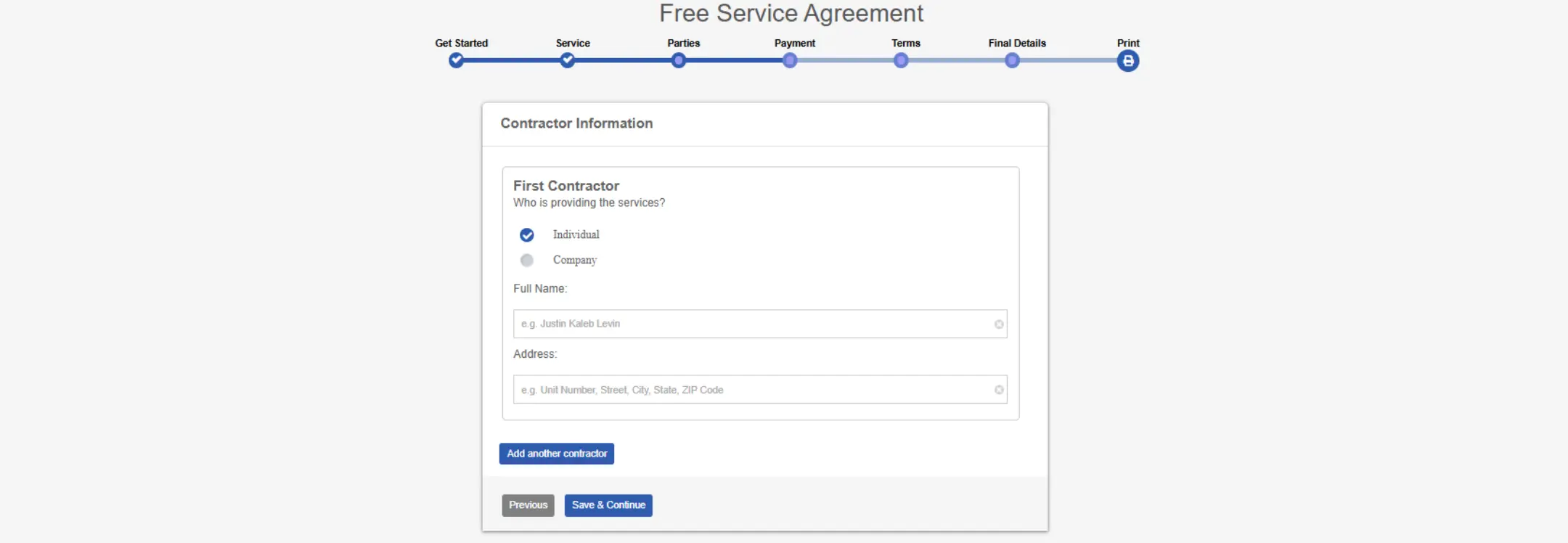
2. Add Party Details
The next step is to enter the legal business names and identification numbers for both the hiring party and the contractor.
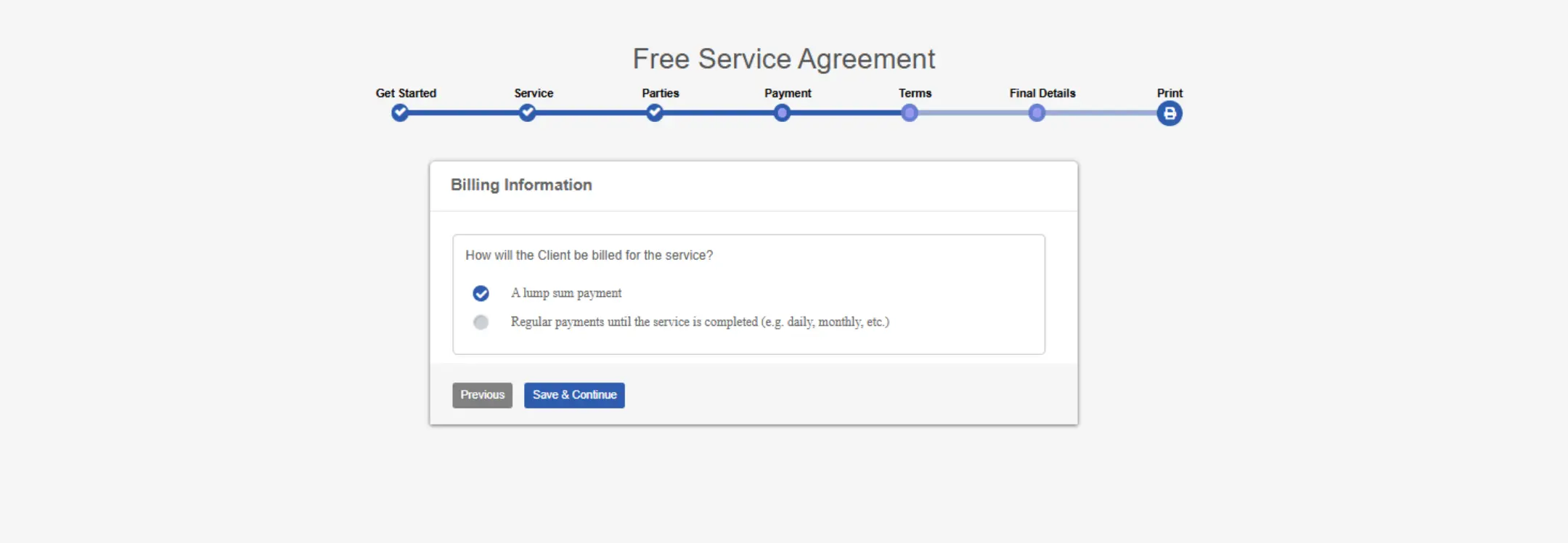
3. Add Payment Details
Users must then specify the compensation rates and the basis of the fee structure.
4. Add Term Details
Defining the duration of the contract and the notice required for termination is a vital part of the process.
5. Preview and Print
The final step is to review the generated document for accuracy and completeness.
Why Choose Ziji Legal Forms for Your Service Agreement?
Ziji Legal Forms stands out because its templates are prepared by experienced legal professionals and are updated to reflect current Canadian federal and provincial requirements. The platform is designed to be easy to use, with no legal jargon or confusion. It provides a simple and affordable way for millions of users to access legal documents they can trust and rely upon.
The platform is focused on the Canadian market, ensuring that nuances like moral rights waivers and PIPEDA compliance are integrated into the forms. This is a critical advantage over generic American templates that may use incorrect terminology or reference laws that do not apply in Canada. Businesses can work on their own schedule and create documents on any device at their convenience.
Digital Execution: Moving Beyond the Paper Trail
Electronic signatures are fully legal and recognized in Canada through PIPEDA and provincial legislation. They carry the same legal weight as a traditional handwritten signature and are often more secure because they contain a digital audit trail. Ziji supports the move toward digital execution by providing documents that are ready for electronic signing.Using electronic signatures allows businesses to close deals faster and reduce paper usage. Platforms that provide certificates of completion and time stamps offer reliable proof of when a document was signed and by whom. This is an essential tool for modern businesses operating in a fast paced digital economy, ensuring that contracts are not just binding but easily verifiable in the event of a dispute.
Conclusion: Avoid Costly Mistakes with Professional Templates
Creating a service agreement without a professional template is a significant risk that can lead to scope creep, payment disputes, and the loss of intellectual property. By addressing key terms like termination, liability, and data protection, Canadian businesses can build strong and legally secure professional relationships. Using Ziji Legal Forms ensures that your contracts are well researched, compliant with federal laws, and tailored for success.
Service Agreement FAQs
1. What is the purpose of a Service Agreement?
Its purpose is to define the scope of work, payment arrangements, timelines, and responsibilities between a contractor and a client.
2. Why should businesses use a Service Agreement?
Businesses should use one whenever they engage an independent contractor to perform services.
3. Can a Service Agreement replace an Employment Agreement?
No. A Service Agreement is designed for contractor relationships and should not be used for employees.
4. Is it better to have a written Service Agreement?
Yes. A written agreement provides clear evidence of the agreed terms and helps protect both parties.
5. Can changes be made after the agreement is signed?
Yes. Any amendments should be made in writing and approved by both parties.
6. Can the Ziji Legal Forms Service Agreement be used anywhere in Canada?
The Ziji Legal Forms Service Agreement can be used in all supported Canadian provinces and territories.
Author
Mandar Sonavane
|
Legal Content Writer at Ziji Legal Forms Inc.
Symbiosis International University
Mandar is a legal content writer specializing in the development of clear, practical, and easy-to-understand legal resources. With a strong focus on legal research, content creation, and plain-language writing, he works closely with our legal professionals to ensure that legal documents and educational materials are accurate, accessible, and user-friendly. At Ziji Legal Forms Inc., Mandar is responsible for researching legal topics, drafting and reviewing content, and helping transform complex legal concepts into straightforward guidance that empowers individuals and businesses to confidently navigate their legal needs.
Reviewed By
Histon Shek
|
General Counsel and Co-Founder at Ziji Legal Forms Inc.
University of Alberta
Histon Shek was called to the Alberta Bar in 2006. He holds a BA in Sociology and Philosophy and an LLB from the University of Alberta. As co-founder of Ziji Legal Forms Inc., he focuses on making legal documents accessible and affordable, overseeing legal integrity and content development.







 Canada
 United States