Independent Contractor Agreement FAQs
What else can an independent contractor agreement be called?
An independent contractor agreement can also be referred to as follows: consulting service agreement, general service agreement, service agreement, or service contract.
What’s an independent contractor agreement?
An independent contractor agreement is a document used to outline the terms of service between the contractor and the client. Independent contractor agreement is used instead of an employment agreement because the independent contractor is not an employee of the client.
How does an employment agreement differ from an independent contractor agreement?
An employment agreement is only used for employees. In all jurisdictions, the employer and employee relationship has tax implications and statutory standards for both parties so an independent contractor agreement should not be used for employees. Independent contractors are freelancers, not employees, and generally differ from employees in having more control over how the work is performed when the service is rendered, unlike employees who are under more direct control and supervision of the employer. The contractor is independent service provider and the independent contractor agreement will reflect this difference.
When to use an independent contractor agreement?
There are many examples of services that can be covered under an independent contractor agreement, for example:
- Information technology service provider
- Web designer
- Construction and home renovation worker such as carpenter, electrician, plumber and landscaper
- Child care worker such as nanny, babysitter, daycare worker
- Educational and instructional provider such as personal fitness trainer, music teacher, and dance instructor
- Caterer
- Decorator
- Photographer
- Musician and DJ (disc jockey)
- Cleaner
- Tax consultant
What should be covered in an independent contractor agreement?
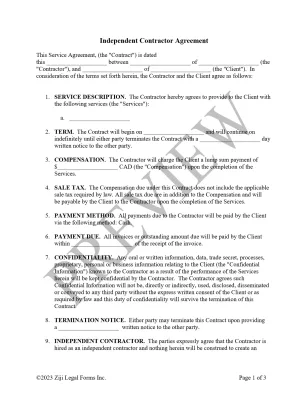
The independent contractor agreement should cover the terms of the services that will be provided so both the contractor and client will know what is expected. Some topics that should be included in the independent contractor agreement are as follows:
- Who are the parties: listing the full name and address of the independent contractor and the client.
- How long is the term: listing how long the contract will last. It can have a fixed term that has an end date or it can continue indefinitely as an ongoing service.
- What kind of work or service will be provided: listing the services the contractor will be providing in detail so both parties will be clear as to what is expected.
- How much is the payment and what is the payment method: listing the cost associated with the service provided. It can be a lump sum payment or a periodic payment. Also describe what type of payment methods will be used to pay the contractor.
- What are the terms of the agreement: listing the terms the parties have agreed to in the independent contractor agreement, dealing with topics such as initial deposit, late payment and interest payment, work expense reimbursement, and contract termination.
- Will there be a confidentiality clause: describing if the contractor will be prevented from sharing sensitive business information or trade secret of the client.
- Will there be an intellectual property clause: describing if the service provided will create any intellectual property, and if so, whether the contractor or the client will own said intellectual property rights that is generated from the agreement.
Can the terms of an independent contractor agreement be modified after signing?
Yes. Any adjustments must be mutually agreed upon by the contractor and the client. To ensure the changes are valid and clearly understood, they should be recorded in writing and signed by both parties.
Do I need a written independent contractor agreement?
In some areas, verbal agreements may be legally recognized, but a written contract is strongly preferred. Putting the terms in writing makes each party’s obligations and expectations clear, which helps prevent confusion and reduces the likelihood of disputes.
What are the consequences if the agreement is breached?
If the contractor or the client fails to uphold their part of the deal, it could be considered a breach of contract. Depending on the situation and applicable law, the other party may have the right to seek compensation, terminate the agreement, or require the original terms to be honored.
How should payment be addressed in the agreement?
The contract should clearly outline the payment structure—whether it’s a one-time fee, hourly rate, or payments tied to specific milestones. It should also detail the payment method and any extra provisions, such as deposits, late payment charges, or expense reimbursements.
Must the agreement comply with local regulations?
Yes. The contract must adhere to the laws in the location where the services are provided. Any term that conflicts with mandatory legal requirements—such as licensing obligations, tax rules, or workplace safety standards—will usually be invalid.
What jurisdictions can use our independent contractor agreement?
You can use our template to create a legal and valid independent contractor agreement for the following jurisdictions:
|
Alberta
British Columbia
Manitoba
New Brunswick
Newfoundland and Labrador
Northwest Territories
Nova Scotia
Nunavat
Prince Edward Island
Saskatchewan
Yukon |
AB
BC
MB
NB
NL
NT
NS
NU
PE
SK
YT |








 Canada
 United States