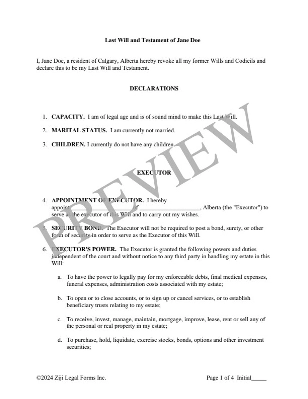
A Last Will and Testament is a crucial legal document that empowers individuals to express their wishes regarding the distribution of their assets after death. Essentially, it serves as a comprehensive set of instructions, guiding an appointed executor through the process of executing the testator's desires after the testator’s passing.
This may sound complex but our customizable Last Will templates at Ziji Legal Forms will enable you to create a valid and comprehensive Last Will that covers various essential aspects:
-
Appointment of Executor: The testator can designate a trustworthy individual responsible for executing the instructions outlined in the Last Will.
-
Distribution of Assets: Specifies how the testator's estate and assets will be divided among beneficiaries, including specific bequests or inheritances.
-
Appointment of Guardianship of Minor Children: Allows the testator to designate a guardian to care for and protect minor children in the event of their death.
-
Appointment of Caretaker of Pets: Permits the testator to assign someone responsible for the care of their pets after they pass away.
-
Debts and Taxes: Addresses the payment of outstanding debts, taxes, and funeral expenses before distributing assets to beneficiaries.
-
Last Requests: Allows the testator to outline final instructions regarding funeral preferences or the forgiveness of debts owed to them.
Why having a Last Will so important?
Having a Last Will is crucial for individuals who want control over the distribution of their assets after death. Any adult of sound mind can and should create a Last Will to dictate how their estate is to be handled after death. When some dies without a valid will, also know as dying intestate, laws of your jurisdiction would dictate asset distribution, potentially leading to unintended consequences. A Last Will ensures that assets are distributed according to the testator's wishes, preventing confusion or disputes among surviving family members.
Is a Last Will Different from a Living Will?
Yes, a Last Will focuses on asset distribution after death, while a Living Will addresses health care preferences when the individual is incapacitated. A Living Will guides family members on medical treatments the individual would accept if unable to provide consent, such as CPR, blood transfusions, or decisions related to starting and ending life support.
Key Terminology in a Last Will:
-
Testator: The individual writing the will. Sometimes a testatrix is used to refer to a female testator but a testator is the commonly used term to refer to both female and male testators.
-
Executor: The person responsible for executing the testator's wishes as appointed in the Last Will.
-
Guardian: A person designated to care for minor children in case of the testator's death.
-
Executor Bond: A bond that ensures beneficiaries are reimbursed if the executor mishandles assets.
-
Trustee: Manages and administers trust assets for minor children until they reach adulthood.
-
Specific Gift: A designated, specific property bequeathed to a beneficiary in the will. Please note that assets that already have a designated beneficiary cannot be given in a Last Will. Examples of this are pension fund proceeds, life insurance policy, annuities etc.
-
Wipeout Clause: Redirects assets to a specified beneficiary if named beneficiaries and heirs die before the testator. This can also be referred to as a total failure clause, total wipe out clause, common tragedy clause, catch all clause, fail safe clause etc., in a Last Will.
Can pets be mentioned in a Last Will?
A Last Will can be used to ensure the well-being of pets by designating a caretaker and allocating a portion of the estate for their care, covering food, grooming, and medical needs.
Do I need to notarize my Last Will and what about witness requirements?
In most jurisdictions, notarization isn't required, but two witnesses are essential. Witnesses must be of sound mind, at least 18 years old, and not beneficiaries in the Last Will. Their presence during the testator's signing of the document ensures its validity. While not mandatory, notarization can expedite the probate process in the courts.
What is probate?
Probate is the legal process overseen by the court where your Will is validated and executed after your death.
What is an affidavit and why is it often signed with the Will?
An affidavit, also known as an affidavit of execution, is a sworn statement confirming that the signing and witnessing of the Will comply with local laws. By signing and notarizing this affidavit, the Will becomes "self-proved" in probate, meaning its validity is typically accepted without further proof unless contested with credible evidence.
Why is it wise to sign an affidavit with the Will?
If the affidavit isn't signed, witnesses may need to appear in probate court to confirm their roles and the signing process. While not mandatory for a valid Will, signing the affidavit saves time and costs during probate. It also spares the executor from tracking down witnesses later.
Where should you store your Will?
Keep your signed Will and Affidavit in a secure place. Avoid using a safety deposit box as your sole storage, as accessing it requires going through probate, where the Will is needed. Store these documents securely yet accessibly for your executor, and inform them of their location.
How frequently should I revise my Last Will?
It is advisable to review and update your Last Will periodically, such as every few years, or whenever you experience a significant life event like marriage, divorce, the birth of a child, or acquiring significant assets. This ensures that your Will stays accurate and aligns with your current intentions.
Is an online Last Will legally binding?
Yes, an online Last Will can be legally binding if it meets your jurisdiction's legal requirements, including proper signing and witnessing. At Ziji Legal Forms, our templates are crafted by our legal experts to comply with legal standards, ensuring the validity of your Will.
Can I appoint alternate executors in my Will?
Yes. You can designate one or more alternate executors to take over if your primary executor is unable or unwilling to act. This ensures your estate is administered smoothly without delays and provides backup options in case of unforeseen circumstances.
Can I leave provisions for stepchildren or children from a blended family?
Absolutely. You can include stepchildren, adopted children, or other non-biological children as beneficiaries in your Will. Be sure to clearly identify each child and specify what they are to receive to avoid confusion or disputes.
Can I include my digital assets in my Will?
Yes. Digital assets, including online accounts, social media profiles, cryptocurrency, digital photos, or cloud files, can be addressed in your Will. Clearly outline instructions for access, management, or distribution to ensure your wishes are honored.
Can I make charitable donations in my Will?
Yes. You can leave gifts or a portion of your estate to registered charities, nonprofits, or organizations that are meaningful to you. Include the charity’s full legal name and the intended amount or asset to ensure your philanthropic wishes are followed.
What happens if I die without a Will in Canada?
If you pass away intestate—without a valid Will—provincial or territorial laws will determine how your estate is distributed. This may not reflect your personal wishes and could lead to disputes among family members. In some cases, if no legal heirs exist, assets may ultimately revert to the Crown.
What jurisdictions can use our Last Will?
You can use our template to create a legal and valid Last Will for the following jurisdictions:
|
Alberta
British Columbia
Manitoba
New Brunswick
Newfoundland and Labrador
Northwest Territories
Nova Scotia
Nunavat
Prince Edward Island
Saskatchewan
Yukon |
AB
BC
MB
NB
NL
NT
NS
NU
PE
SK
YT |








 Canada
 United States