TL;DR- Retainer Service Agreements provide Canadian businesses with stable income and guaranteed professional availability.
- These contracts differ from project-based work by establishing recurring fees, flexible scopes, and structured renewal terms.
- Key terms must define a precise scope of work, response times, and clear rules for unused monthly hours.
- Interest and penalty clauses for late payments must comply with the federal Interest Act and the Criminal Code.
- Businesses must manage relationships carefully to prevent the misclassification of independent contractors under federal guidelines.
- Creating compliant Service Agreements is simple and secure when using Ziji Legal Forms to draft custom contracts.
Introduction: Why Recurring Services Need Different Agreements
Standard contracts focus on a single transaction. A business hires a provider to complete a task. The work ends when the task is done. This model is great for one-time projects. It does not work well for ongoing business relationships. When a client needs continuous help, they need a different legal framework. Regular business deals do not fit recurring work.
Providers need guaranteed income to reserve their time. At the same time, clients need a guarantee that their tasks will be prioritized. This is where specialized contracts, known as Retainer Service Agreements, become essential. A recurring relationship requires clear guidelines about availability, fees, and operational boundaries. Without these specific rules, both parties risk frustration and disputes over workload. A structured contract ensures that the ongoing partnership remains mutually beneficial and sustainable.
What Is a Retainer Service Agreement
Definition and Core Purpose
A retainer service agreement is a contract where a client pays a regular fee in advance. This fee secures ongoing access to a professional. This arrangement is different from standard service contracts because the payment does not cover just one completed task. Instead, the fee reserves the provider's dedicated time and expert attention.
The core purpose is to establish a stable and reliable partnership. The client gains peace of mind knowing they have immediate access to expertise. The service provider receives steady, predictable cash flow to support their operations. It turns a series of separate transactions into a continuous, stable business relationship.
How Retainers Differ from Project-Based Agreements
Project-based agreements focus on clear deliverables with a fixed end date. Once the provider submits the finished work, the contract is complete. Retainer arrangements are built on continuous service and predictable availability. There is no single end goal, but rather a commitment to provide ongoing assistance.
Payment structures also differ significantly between these models. Project-based work involves invoicing at specific milestones or upon completion of the task. Retainer systems rely on pre-scheduled payments at the start of each billing period. This distinction shifts the focus from short-term tasks to long-term collaboration.
Common Industries Using Retainers
Many sectors rely on this structure to manage client relations effectively. Freelancers, consultants, and agencies frequently use these contracts to stabilize their income. Clients benefit from having reliable, on-demand support without the need to hire full-time employees.
Legal professionals, IT support companies, and marketing agencies are prime examples of businesses that use these tools. Web developers and graphic designers also find them useful for ongoing maintenance tasks. Any field that requires regular, high-priority support can benefit from structured retainer arrangements. Many organizations rely on a standard Service Agreements template to initiate these professional partnerships.
When to Use a Retainer Agreement
Ongoing Consulting or Advisory Services
Clients often need regular strategic advice rather than specific deliverables. A business owner might want to consult with a management advisor on a weekly basis to review corporate performance. In these scenarios, project-based contracts are impractical because the exact advisory needs change constantly.
A retainer contract is ideal for ongoing advisory relationships. It allows the advisor to remain on standby, ready to answer questions as they arise. The client gets consistent guidance, and the advisor has a predictable schedule. It creates a seamless flow of communication and strategic planning.
Marketing, Design, IT Support, and Legal Services
Certain technical and creative fields require continuous care to keep operations running smoothly. A website needs regular security updates, backups, and minor design adjustments. A marketing team must constantly monitor ad campaigns and adjust strategies.
These situations are perfect for retainer arrangements. Instead of signing a new contract for every small website fix, the client pays a monthly fee for continuous maintenance. This keeps the systems running without administrative delays. It also allows the service provider to dedicate specific hours each month to proactive improvements.
Situations Requiring Predictable Availability
Some businesses experience sudden issues that require immediate professional attention. A server might crash, or a legal issue might arise without warning. Hiring a provider in the middle of a crisis is expensive and slow.
A retainer guarantees that the professional will respond within an agreed timeframe. The client pays to ensure they are at the front of the queue when help is needed. It functions like an insurance policy for professional support. For many businesses, this guaranteed availability is the most valuable part of the contract.
Retainer Versus Project-Based Service Agreements
Payment Structure Differences
Project-based agreements usually involve a single lump sum or milestone-based payments. The client pays a portion upfront, some during the project, and the rest upon completion. This structure ties compensation directly to specific results.
Retainers operate on a recurring billing cycle instead. The client pays a fixed fee at the start of each month or quarter. This provides the professional with steady revenue and makes budgeting simple for the client. It removes financial uncertainty and simplifies cash flow management.
Scope Flexibility Variations
Project contracts have a very strict scope of work. Any task outside the original plan requires a formal change order and extra fees. This structure is rigid and does not adapt well to shifting daily priorities.
Retainer agreements offer greater flexibility. The client can shift priorities from week to week within the agreed limits. If a marketing client needs blog posts one month and social media ads the next, the retainer accommodates this change easily. This adaptability is crucial for businesses operating in fast-paced environments.
Duration and Renewal Terms
Project agreements naturally expire when the project is finished. The relationship is temporary and ends once the final deliverable is approved. To continue working together, the parties must sign a completely new contract.
Retainer agreements are designed for long-term use. They often run for several months or years and include automatic renewal terms. This continuous structure helps build deeper professional partnerships over time. The automatic renewal clause ensures that the support remains continuous, preventing any gaps in service.
Termination Expectations
Ending a project contract early can be complex. If a project is cancelled halfway through, the parties must calculate the value of the completed work and settle any outstanding costs. This process frequently leads to disputes.
Retainers have clearer termination terms. They typically allow either party to end the contract by giving thirty days of notice. This gives both sides time to transition the work without sudden disruptions. It provides a fair and professional exit strategy for both businesses.
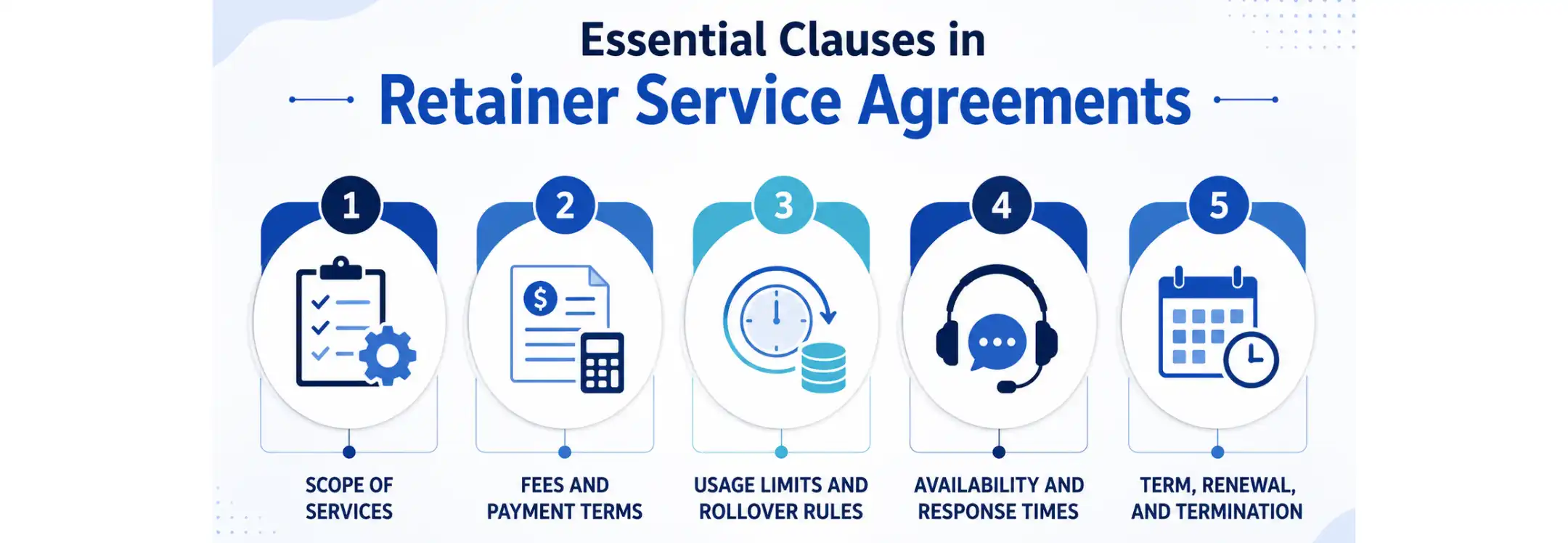
Essential Clauses in Retainer Service Agreements
Scope of Services
Even though a retainer is flexible, it must still have clear boundaries. The contract should outline the types of tasks the provider will perform and what is excluded. Without this definition, the provider risks doing too much work for a fixed fee.
A good scope section explains the general categories of service. It might state that the fee covers website maintenance and bug fixes but excludes complete website redesigns. This prevents misunderstandings and protects both parties. The scope should be detailed enough to prevent scope creep.
Fees and Payment Terms
The fee section must state the exact payment amount and when it is due. In Canada, payments are usually due on the first day of the billing cycle before any work begins. This section should also state whether the fee is inclusive of taxes like Goods and Services Tax or Harmonized Sales Tax.
It is also important to outline late payment consequences, such as interest or temporary service suspension. Any late payment fees must comply with federal regulations. The payment terms should also address how expenses are handled and approved.
Usage Limits and Rollover Rules
A major source of conflict is how unused hours are handled. If a client pays for twenty hours of work but only uses ten, those extra hours must be addressed. The contract must state whether those hours expire or carry over.
The most common approach is a use-it-or-lose-it rule where unused hours expire at the end of the month. This ensures the provider can manage their monthly availability. If hours do carry over, the agreement should limit how long they remain valid to prevent sudden rushes of work.
Availability and Response Times
Since the client is paying in advance, they expect the provider to be available. The agreement must define what that availability looks like. This includes setting typical working hours and specifying communication channels.
It is also vital to include response times for different levels of urgency. An IT provider might promise to respond within two hours for critical server errors and twenty-four hours for minor inquiries. This manages expectations and maintains trust between the parties.
Term, Renewal, and Termination
This clause defines how long the agreement lasts and how it can be ended. It should specify whether the contract has a fixed end date or if it renews automatically. Many retainer arrangements renew on a month-to-month basis.
The termination section must outline the required notice period for ending the contract. A thirty-day written notice is standard for recurring services. This ensures that both businesses have sufficient time to wrap up ongoing tasks.
Common Retainer Agreement Mistakes
Treating Retainers Like Open-Ended Work
Many professionals make the mistake of agreeing to unlimited support for a flat fee. This often leads to severe scope creep, where the client requests more and more work over time. The provider quickly becomes overworked and underpaid.
To avoid this issue, the agreement must place clear limits on the volume of work. It should define a maximum number of hours or specific deliverables included in the monthly rate. Any work beyond this limit must trigger additional hourly fees.
Failing to Set Usage Boundaries
If a contract does not explain what happens to unused hours, disputes are inevitable. Clients may assume they can accumulate unused hours and demand eighty hours of work in a single week. This can easily disrupt the provider's business.
A clear boundary must be established in writing from the beginning. Setting a strict monthly expiration for unused hours protects the provider's schedule. It also encourages the client to utilize the services consistently throughout the contract term.
Not Defining Termination Conditions Clearly
Ending a professional relationship without clear rules can lead to legal disputes and financial loss. If a client cancels a retainer mid-month, the provider may lose expected income. If a provider leaves suddenly, the client is left without support.
A well-drafted contract avoids this confusion by setting out precise notice requirements. It must state whether termination notice must be delivered in writing and how outstanding payments are handled. This ensures a clean and fair transition.
Legal and Compliance Considerations
Ensuring Fair Payment Structures
In Canada, contract interest and late fees are governed by strict federal laws. Under Section 4 of the federal Interest Act, any interest rate stated in a contract must be expressed as an annual percentage. If a contract states a monthly rate but fails to declare the annual equivalent, the legally recoverable rate is capped at five percent per year. Stating an interest rate of one point five percent per month without declaring the annual equivalent of eighteen percent will result in the rate defaulting to five percent.
Additionally, Canada lowered its criminal rate of interest under Section 347 of the Criminal Code to an annual percentage rate of thirty-five percent, effective January 1, 2025. This limit applies to all late payment fees and penalties that function as interest, meaning service providers must ensure their late payment clauses remain well below this threshold. The new regulations provide tiered exemptions for commercial loans over ten thousand dollars, but standard service relationships remain under the strict thirty-five percent limit.
Avoiding Misclassification Issues
Another critical risk in Canada is worker misclassification. The Canada Revenue Agency examines the actual working relationship to decide if a worker is an independent contractor or an employee. They look at factors like control over the work, ownership of tools, subcontracting ability, and financial risk. If a retainer mimics a salary and the worker operates under direct supervision, the agency can classify them as an employee. This mistake leads to retroactively assessed payroll taxes, Canada Pension Plan payments, and Employment Insurance premiums.
Businesses must also understand the concept of dependent contractors. Under Canadian law, a dependent contractor is a worker who depends economically on one client. This dependency is often shown by near-complete exclusivity. In McKee v. Reid's Heritage Homes, the court defined this category clearly. In Keenan v. Canac Kitchens, the court ruled that these workers deserve reasonable notice, upholding a twenty-six month notice period. The Thurston case clarified that near-exclusivity requires earning substantially more than half of all income from one client.
Documentation for Recurring Services
Proper documentation is also essential for tax compliance. In Canada, services are subject to Goods and Services Tax or Harmonized Sales Tax depending on the location of the client. Independent contractors with annual taxable sales exceeding thirty thousand dollars must register for and collect this tax. Under the Excise Tax Act, a retainer payment is usually treated as a deposit.
It is not subject to tax until the supplier applies it to an invoice or if the deposit is forfeited. If a deposit is forfeited because of a cancellation, Section 182 of the Excise Tax Act deems that tax was included in the forfeited amount. This tax is calculated as a fraction of the forfeited amount. In THD Inc. v. The Queen, the Tax Court of Canada confirmed that damages or forfeited payments are deemed tax-inclusive. Businesses must draft clear clauses to handle these tax implications.
How to Create Retainer Agreements Using Ziji Legal Forms
To Create Retainer Service Agreements that are legally sound, businesses can use online legal platforms. Ziji Legal Forms provides a streamlined process to draft these documents. Understanding the step-by-step creation process helps ensure that all critical clauses are included and legally compliant. This ensures that the professional relationship is protected from the start.
1. Choose template
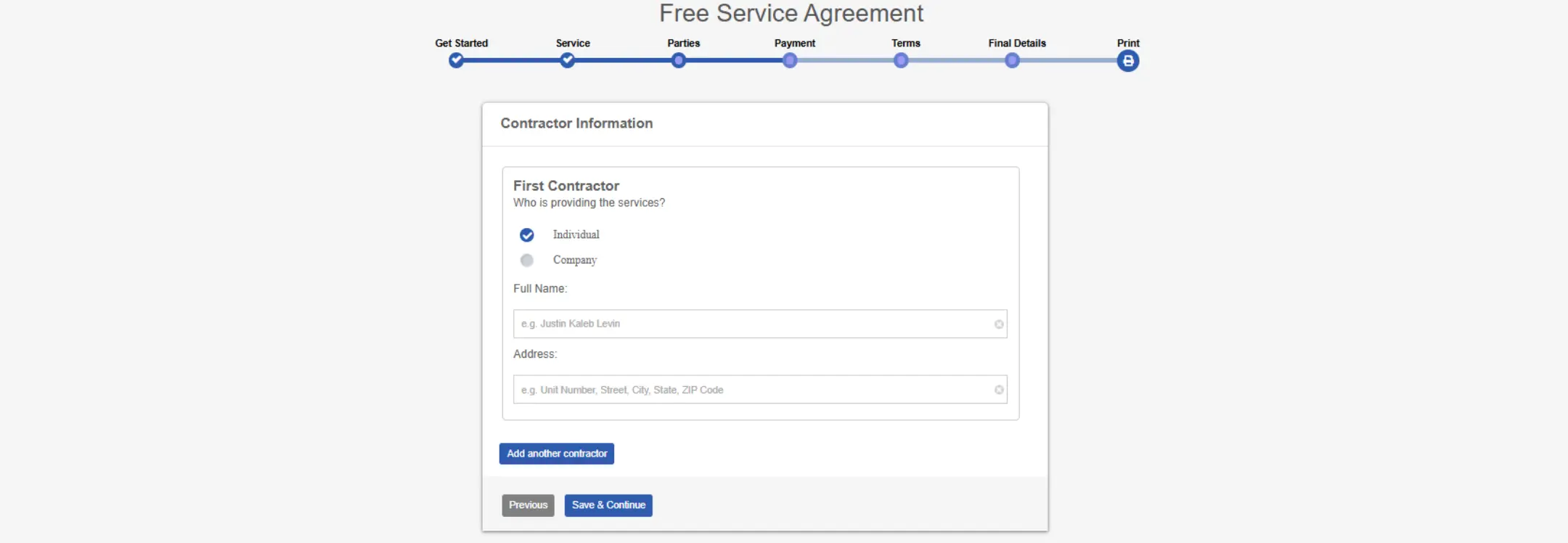
2. Add Parties Details
The user enters the full legal names and business addresses of the service provider and the client.
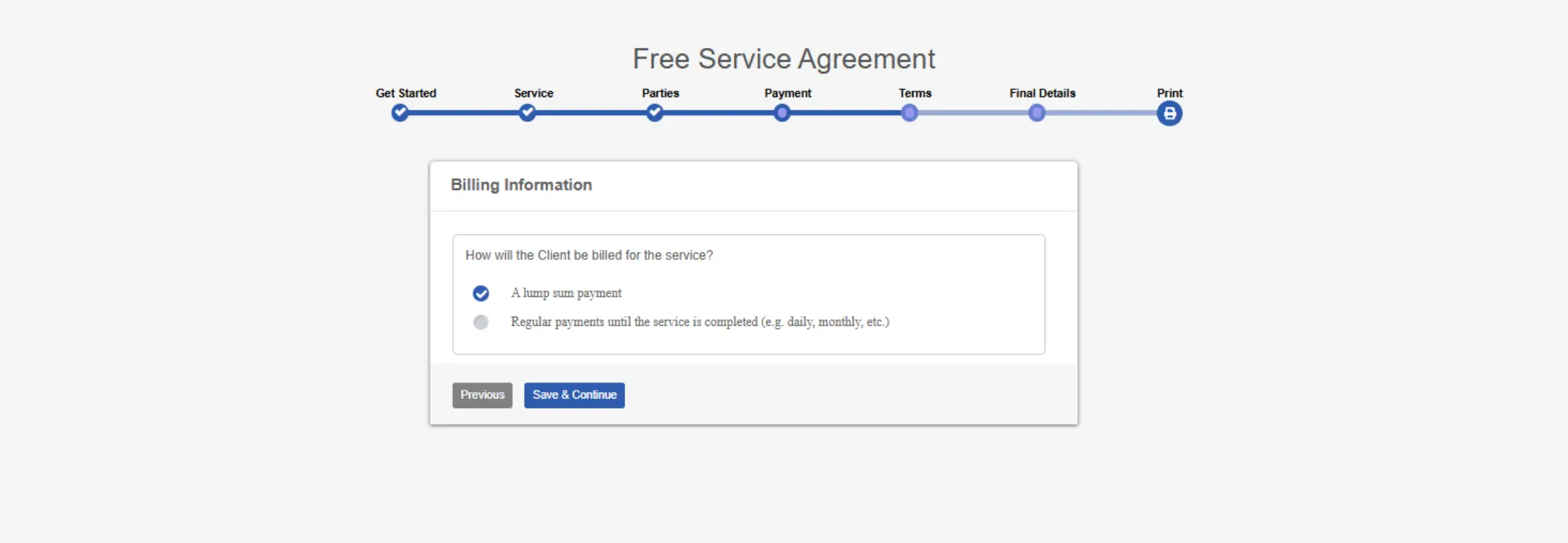
3. Add Payment Details
The user inputs the recurring retainer fee, the billing schedule, and the applicable tax details.
4. Add Terms Details
The user specifies the start date, the renewal terms, and the required notice period for termination.
5. Preview and print
The user reviews the generated contract for accuracy, downloads the PDF file, and prints or signs it.
Template Features Supporting Retainer Structures
The Ziji Legal Forms platform provides specialized tools to help businesses draft reliable contracts. The platform offers customizable templates that feature built-in sections to define monthly hour limits, rollover parameters, and specific response times. This ensures that professionals do not leave important operational details out of the agreement. It provides a simple way to protect business interests.
The platform also includes compliant clauses for Canadian interest rules and tax disclosures. This helps businesses avoid complex regulatory mistakes without needing expensive legal counsel. The platform helps businesses Create Service Agreements quickly and efficiently. It is a simple and cost-effective way to secure professional relationships. Users can easily create a professional and legally sound document in minutes.
Conclusion: Build Strong Long-Term Relationships with Clear Retainer Agreements
Entering into long-term professional relationships requires absolute clarity and mutual trust from the very start. Retainer arrangements offer incredible stability for both clients and service providers when they are supported by robust contracts. By clearly defining the scope of work, payment structures, usage limits, and termination terms, businesses can avoid common disputes. It is also essential to ensure that all contracts comply with Canadian tax laws and interest regulations to protect corporate assets. Using high-quality Online Service Agreements makes it easy to draft compliant and precise contracts. Secure your professional partnerships today by using a Service Agreements Canada template with confidence.
Learn to draft Retainer Service Agreements in Canada. Comply with the Interest Act and avoid CRA misclassification audits.
Service Agreement FAQs
1. What is a Service Agreement?
A Service Agreement is a legal contract that sets out the terms of the working relationship between a client and an independent contractor.
2. When should I use a Service Agreement?
A Service Agreement should be used whenever an independent contractor is hired to provide services for a client.
3. How is a Service Agreement different from an Employment Agreement?
A Service Agreement is intended for independent contractors, while an Employment Agreement is used for employees and is governed by applicable employment laws.
4. Is a written Service Agreement necessary?
Although verbal agreements may be recognized in some situations, a written agreement provides greater clarity and legal protection for both parties.
5. Can a Service Agreement be changed after signing?
Yes. Any changes should be agreed to by both parties and recorded in writing.
6. Which jurisdictions can use the Ziji Legal Forms Service Agreement?
The Ziji Legal Forms Service Agreement can be used in all supported Canadian provinces and territories.
Author
Mandar Sonavane
|
Legal Content Writer at Ziji Legal Forms Inc.
Symbiosis International University
Mandar is a legal content writer specializing in the development of clear, practical, and easy-to-understand legal resources. With a strong focus on legal research, content creation, and plain-language writing, he works closely with our legal professionals to ensure that legal documents and educational materials are accurate, accessible, and user-friendly. At Ziji Legal Forms Inc., Mandar is responsible for researching legal topics, drafting and reviewing content, and helping transform complex legal concepts into straightforward guidance that empowers individuals and businesses to confidently navigate their legal needs.
Reviewed By
Histon Shek
|
General Counsel and Co-Founder at Ziji Legal Forms Inc.
University of Alberta
Histon Shek was called to the Alberta Bar in 2006. He holds a BA in Sociology and Philosophy and an LLB from the University of Alberta. As co-founder of Ziji Legal Forms Inc., he focuses on making legal documents accessible and affordable, overseeing legal integrity and content development.








 Canada
 United States