TL;DR
- Worker classification is determined by actual working relationships, not contract labels.
- The Canada Revenue Agency evaluates control, tool ownership, and financial risk.
- Independent contractors automatically own their creative works unless assigned in writing.Vague contracts increase the likelihood of scope creep and payment disputes.
- Organizations face severe financial penalties and back taxes for worker misclassification.
- You can use Ziji Legal Forms' Customizable Templates to easily create Indepenedent Contractor Agreements and avoid any potential risks from incorrect drafting.
Navigating Independent Contractor Engagements in the Canadian Market
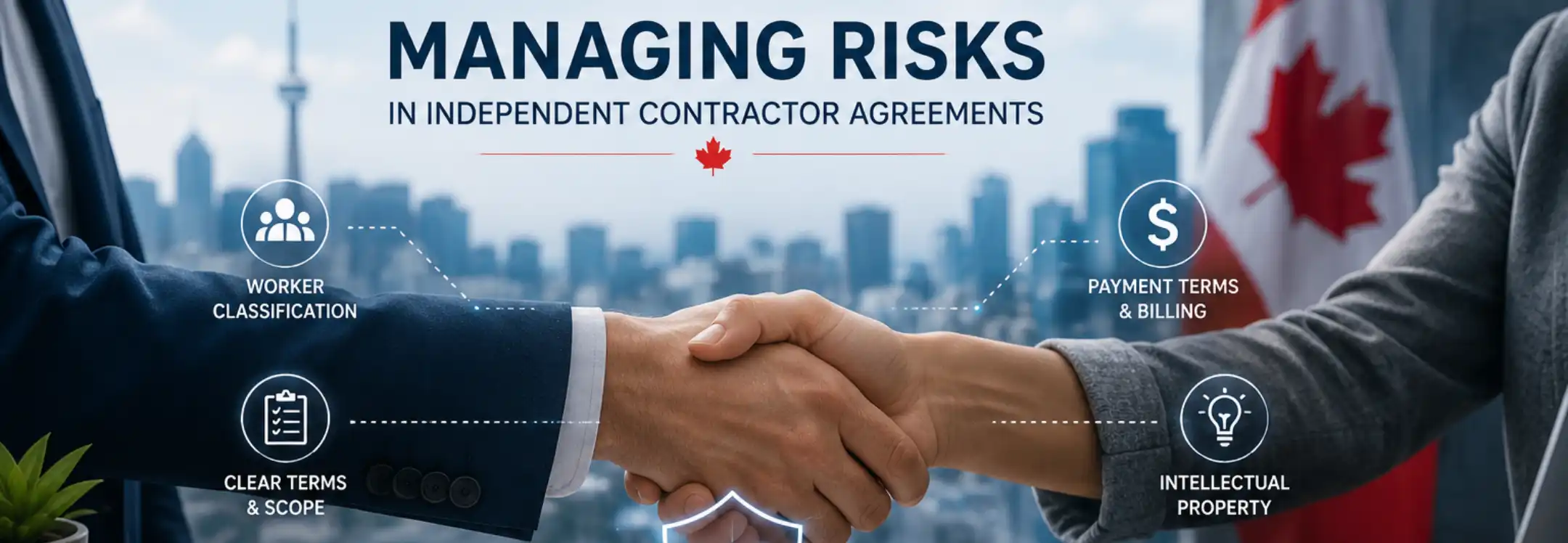
Canadian organizations increasingly utilize self-employed talent to manage fluctuating workloads. This strategic agility comes with complex legal responsibilities under federal legislation. Engaging external talent requires a clear understanding of the regulatory environment to avoid costly operational and financial pitfalls. A poorly structured relationship can quickly lead to regulatory scrutiny, tax liabilities, and legal disputes. Businesses must proactively establish robust frameworks to govern these engagements. Implementing a clear Independent Contractor Agreement Canada is the first step toward mitigating these organizational vulnerabilities.
Operational and Financial Vulnerabilities in Contractor Relations
Engaging external professionals introduces several inherent risks that can disrupt business operations. Identifying these core risk areas is essential for creating robust protective measures.
Vulnerabilities Born from Ambiguous Contract Terms
Ambiguous terms within an agreement create dangerous gaps that both parties can exploit during disagreements. Without a comprehensive Independent Contractor Agreement template, crucial aspects like project timelines and performance standards remain undefined. This lack of clarity often results in differing expectations regarding deliverables, undermining the professional relationship and increasing the likelihood of legal escalation.
Controlling Project Scope and Timeline Deviations
Scope creep occurs when work requirements expand beyond the initial agreement without corresponding adjustments to compensation or timelines. This expansion drains internal resources and delays critical milestones. To control this risk, parties must clearly define project boundaries and establish a formal mechanism for modifying deliverables. Setting precise operational deadlines ensures both parties remain aligned throughout the entire engagement.
Minimizing Compensation Conflicts and Billing Friction
Financial disputes often arise from vague payment terms, irregular invoicing, or unexpected expense claims. Clear compensation structures must outline exact payment rates, billing cycles, and invoicing procedures. Specifying these details prevents misunderstandings and ensures smooth cash flow for the provider. Addressing these financial details early reduces billing friction and supports a productive working relationship.
Safeguarding Proprietary Rights and Creative Assets
Under Canadian copyright law, independent contractors automatically own the copyright to original works they create. This ownership remains with the contractor unless a written contract explicitly overrides this default rule. Organizations must ensure their agreements contain robust intellectual property assignment clauses to secure full ownership of creative outputs. Additionally, contracts must include a waiver of moral rights, which protect the integrity of the work and the author's right to be cited, as moral rights cannot be assigned under Canadian law. Without these explicit provisions, the hiring entity only obtains an implied license, leaving actual ownership with the creator.
Protecting Sensitive Information and Mitigating Data Leaks
Sharing sensitive data with external workers poses privacy and confidentiality challenges. In Canada, the Personal Information Protection and Electronic Documents Act regulates how commercial organizations handle personal data. Organizations remain legally accountable for data breaches even when the breach occurs through a third party processor. Agreements must include strict confidentiality clauses and data protection standards to comply with privacy legislation. This includes establishing mandatory breach reporting protocols and ensuring the contractor implements reasonable security safeguards.
Managing Contractual Breaches and Resolving Disputes
Contractual disputes can arise despite the best intentions of both parties. Understanding the nature of breaches and resolution pathways is critical for minimizing commercial disruption.
Classification of Contractual Infractions
Contract breaches generally fall into material or minor categories. A material breach occurs when one party fails to perform a core obligation, such as refusing to pay or failing to deliver agreed services. A minor breach involves smaller deviations, such as missing a minor deadline while still completing the overall project. Categorizing the breach helps determine the appropriate legal response.
Systematic Conflict Escalation and Resolution Pathways
When conflicts arise, parties should follow a structured escalation process to avoid costly court battles. The initial step should involve direct negotiation to find a mutually acceptable compromise. If negotiation fails, formal mediation or binding arbitration can resolve the dispute efficiently. Including these dispute resolution pathways in the initial agreement ensures a clear roadmap for conflict management. This proactive setup minimizes commercial disruption and keeps legal fees to a minimum.
Preventing Disagreements via Structural Contractual Clarity
The most effective way to prevent disputes is by drafting highly detailed agreements before starting any work. A well structured agreement defines the rights, responsibilities, and expectations of each party in clear terms. This proactive approach reduces misunderstandings and provides a solid legal reference if issues emerge later, safeguarding the interests of both parties.
Legal Compliance and the Perils of Worker Misclassification
Worker misclassification represents a major compliance risk for Canadian businesses. Understanding these classification rules is vital for avoiding severe regulatory penalties.
National Criteria for Worker Classification
Evaluating the relationship between a service provider and a hiring organization requires analyzing working conditions under Canadian common law and administrative guidelines, specifically the Canada Revenue Agency guide RC4110. Regulators utilize a multi-layered legal test focusing primarily on the degree of control the hiring entity exerts over the worker's schedule and methods. Additionally, tool ownership is analyzed, as true independent contractors generally invest in and maintain their own equipment rather than relying on employer resources.
Other essential criteria include the worker's opportunity for profit, risk of loss, and integration into the core business. Under the Canada Labor Code, all workers are presumed to be employees unless the hiring organization proves otherwise, shifting the burden of proof to the employer.
Liabilities and Legal Penalties for Incorrect Categorization
Failing to classify workers correctly under Canadian law leads to immediate and severe financial and legal penalties. If the Canada Revenue Agency reclassifies a worker, the business becomes liable for all unremitted payroll deductions, including the employer and employee portions of Canada Pension Plan contributions and Employment Insurance premiums. The organization must also pay outstanding income tax withholdings, along with significant interest and administrative penalties. Furthermore, reclassified workers can demand retroactive compensation for unpaid overtime, general holiday pay, and statutory vacation pay under employment standards legislation.
Termination can also trigger costly wrongful dismissal claims or severance liabilities if the individual is deemed an employee or dependent contractor. Under the Canada Labor Code, administrative monetary penalties range from one thousand to twelve thousand dollars or more per violation.
Ensuring Corporate Audit Readiness
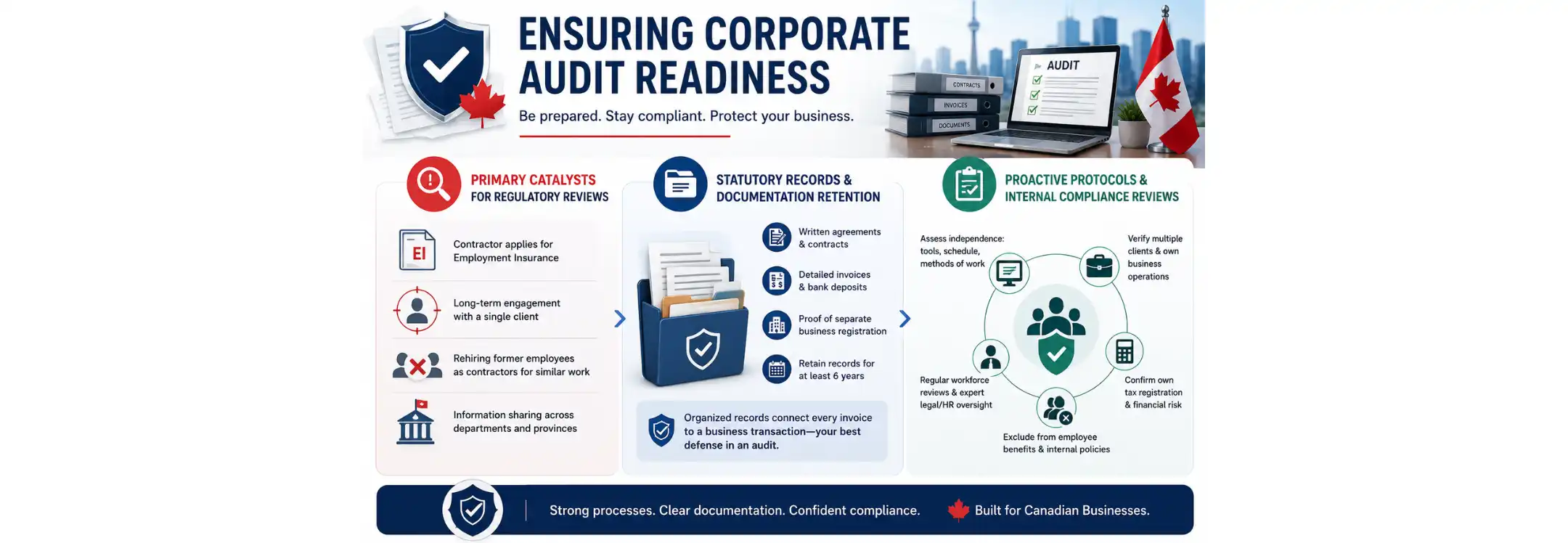
Canadian businesses must maintain a high state of audit readiness to defend their contractor classifications. Having structured processes in place ensures that audits proceed smoothly.
Primary Catalysts for Regulatory Reviews
Several business activities can trigger an unexpected payroll or worker classification audit by the Canada Revenue Agency. A common catalyst occurs when a terminated contractor applies for Employment Insurance benefits, prompting regulators to examine the working relationship. Long term engagements where an individual works exclusively for a single client also raise flags, especially if the worker has no other active clients. Additionally, rehiring former employees as independent contractors to perform similar duties is a high risk activity that triggers reviews. Regulators also share information across departments, meaning provincial audits can lead to federal tax investigations.
Statutory Records and Documentation Retention
Maintaining organized financial and legal records is the most effective defense against an aggressive regulatory audit. The Canada Revenue Agency routinely requests written agreements, detailed invoices, bank deposits, and proof of separate business registrations. Under Canadian tax law, businesses must retain all supporting documentation, invoices, and contracts for at least six years. These records should clearly connect each contractor invoice to a specific business transaction within the general ledger. Proactively organizing these records demonstrates credibility and ensures a smoother, shorter audit process.
Proactive Protocols and Internal Compliance Reviews
To mitigate classification risks, organizations should establish robust internal compliance protocols and conduct regular workforce reviews. This involves examining active contractor relationships to ensure that operational practices align with the written contract. Businesses must verify that contractors operate independently, use their own tools, set their own schedules, and handle their own tax registrations. Additionally, organizations should maintain clear boundaries by preventing contractors from participating in internal employee benefit plans. Partnering with legal and human resources experts to review these arrangements helps ensure ongoing compliance.
Preemptive Risk Management Strategies
Managing Risk in Independent Contractor Agreement requires a proactive approach that begins long before any services are performed. These practices lay the foundation for a successful and compliant professional partnership.
Strategic Drafting and Standardized Agreements
A proactive approach to risk management begins before any work commences. Utilizing a comprehensive Independent Contractor Agreement establishes clear boundaries and defines the legal nature of the business relationship. This agreement must explicitly state that no employer-employee relationship exists and that the contractor handles personal tax deductions. However, the contract must accurately reflect actual working conditions, as courts prioritize the reality of the relationship over written labels. Utilizing a robust Independent Contractor Agreement template ensures all vital clauses are included.
Standardized Change Control and Task Variations
Project scopes often evolve as business needs change, leading to operational confusion and timeline delays. To manage this risk, agreements must include a formal change management procedure that governs how work variations are handled. Any adjustments to the scope of work, deliverables, compensation, or deadlines must be documented in writing and signed by both parties. Establishing these change control procedures prevents unauthorized scope creep and keeps both parties aligned throughout the project, reducing the risk of billing disputes.
Structuring Contract Dissolution and Exit Provisions
A clear dissolution strategy is vital for protecting businesses when ending a contractor engagement. The agreement must outline specific termination procedures, notice periods, and conditions for termination with or without cause. This contractual clarity prevents sudden disruptions and minimizes the risk of legal claims upon contract termination. It is also essential to define ownership of outstanding deliverables and the process for final payments, ensuring both parties conclude the relationship professionally.
Liability Insurance and Indemnification Shifting
Shifting potential financial liabilities away from the hiring organization is another key component of risk management. Agreements should require contractors to carry independent commercial general liability insurance to cover any damages caused during their work. Additionally, the contract must include strong indemnification clauses holding the contractor responsible for losses arising from negligence or breach of contract. This risk transfer mechanism protects the business from third party claims and ensures the contractor remains financially accountable.
Executing Agreements Through Ziji Legal Forms
Using a specialized platform simplifies the contract creation process while ensuring legal compliance. Ziji Legal Forms offers an efficient pathway to generate professional, jurisdictionally appropriate agreements.
1. Choose the proper template
2. Provide the service specifications
The business enters the precise details of the project, including scope of work, expected deliverables, and operational milestones.
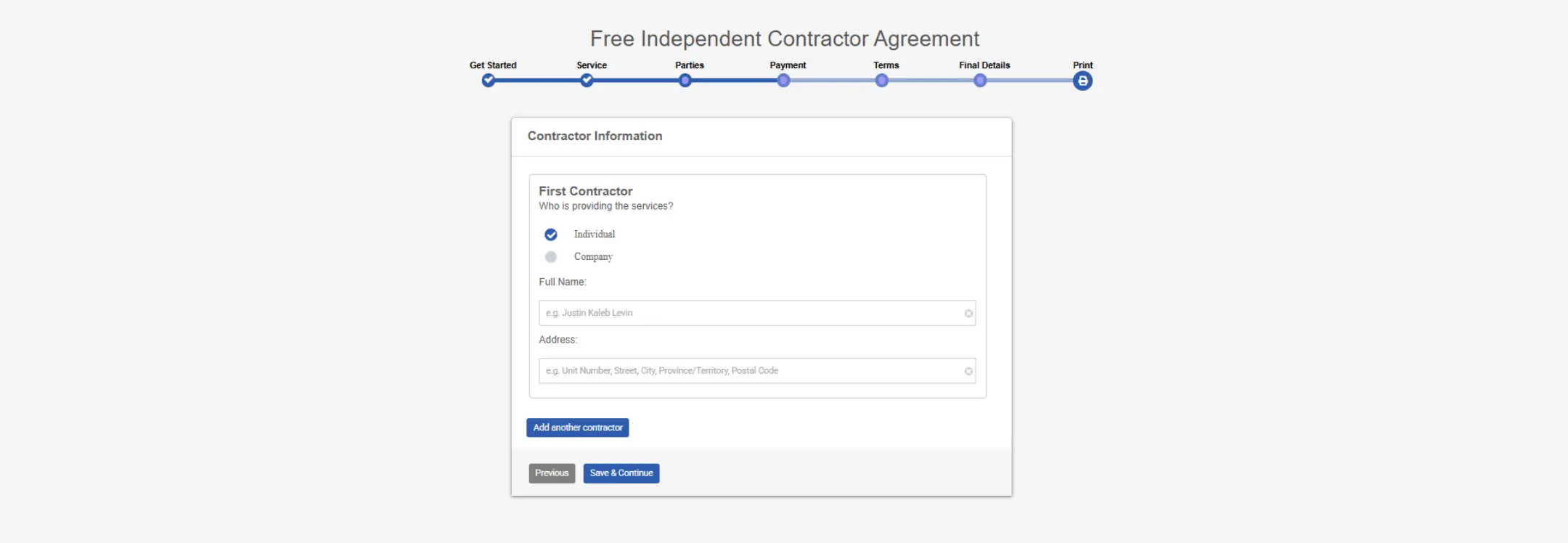
3. Define party details
Add the legal names, business registration details, and tax information for both parties.
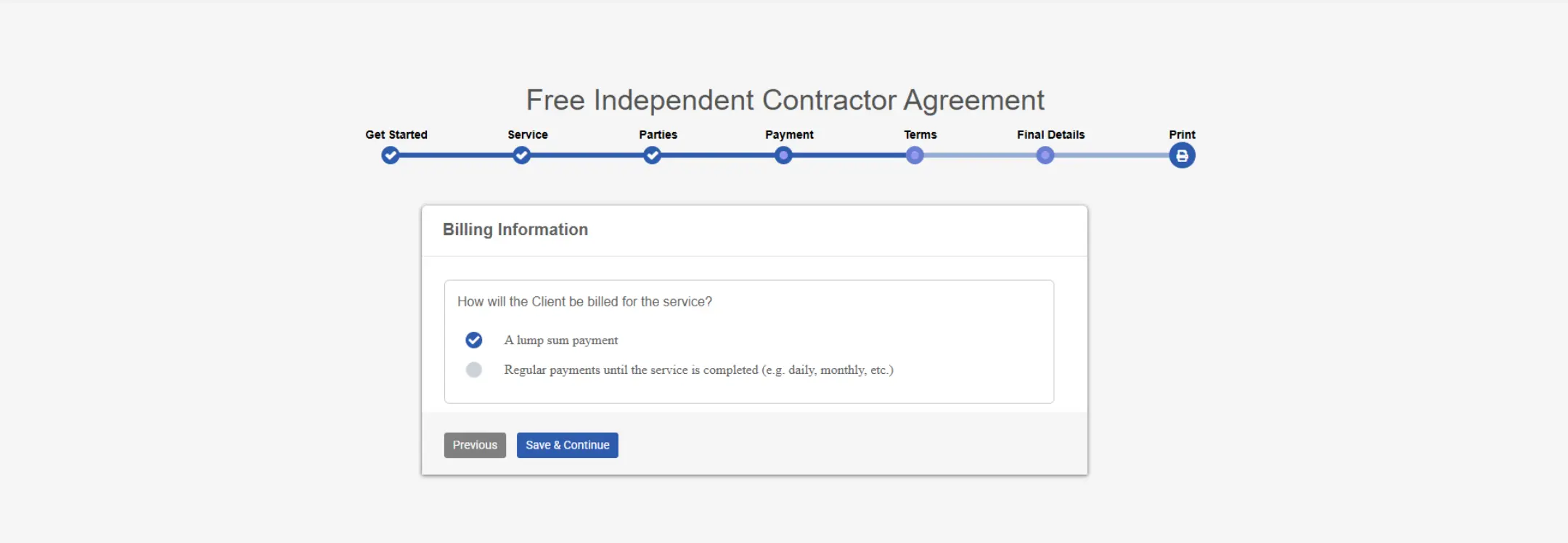
4. Add Payment Terms
Choose the compensation structure, payment schedule, and invoicing requirements for the agreement.
5. Preview document
Both parties conduct a final review of the completed contract and sign it digitally to establish a binding legal relationship.
Advantages of Deploying the Ziji Legal Forms Solution
Drafting an Online Independent Contractor Agreement using a specialized platform offers numerous operational advantages for modern businesses. Ziji Legal Forms provides a streamlined, secure environment to Create Independent Contractor Agreement that aligns with federal and provincial regulations. By utilizing automated workflows, companies can eliminate the risks associated with generic agreements and ensure that all essential protective clauses are included. This targeted approach saves valuable time, reduces legal drafting costs, and provides peace of mind during regulatory audits. Ultimately, the platform empowers organizations to build strong, compliant relationships with independent talent across Canada.
Concluding Remarks
Managing risk in independent contractor relationships requires constant vigilance and robust contractual planning. Canadian businesses must look beyond basic labels and ensure that their actual working relationships match the written terms of the contract. Executing robust policies and maintaining clear boundaries are key elements of Managing Risk in Independent Contractor Agreement within Canadian markets. Proactively protecting intellectual property rights and maintaining strict data security standards are essential for long term success.
Utilizing specialized templates from Ziji Legal Forms helps organizations draft legally sound and compliant agreements. By addressing these critical compliance areas early, companies can significantly reduce the risk of tax audits and legal disputes. Implementing these protective measures ensures a secure and productive environment for engaging top tier independent talent.
Independent Contractor Agreement FAQs
1. What is the purpose of an Independent Contractor Agreement?
Its purpose is to define the scope of services, payment arrangements, timelines, and responsibilities between a contractor and a client.
2. Why should businesses use an Independent Contractor Agreement?
Businesses should use one whenever they engage an independent contractor to perform services outside of an employment relationship.
3. Can an Independent Contractor Agreement replace an Employment Agreement?
No. It is intended for contractor relationships and should not be used for employees.
4. Is it better to have a written Independent Contractor Agreement?
Yes. A written agreement clearly records the agreed terms and helps protect both parties if disputes arise.
5. Can changes be made after the agreement is signed?
Yes. Any amendments should be made in writing and approved by both parties.
6. Can the Ziji Legal Forms Independent Contractor Agreement be used anywhere in Canada?
The Ziji Legal Forms Independent Contractor Agreement can be used in all supported Canadian provinces and territories.
Author
Mandar Sonavane
|
Legal Content Writer at Ziji Legal Forms Inc.
Symbiosis International University
Mandar is a legal content writer specializing in the development of clear, practical, and easy-to-understand legal resources. With a strong focus on legal research, content creation, and plain-language writing, he works closely with our legal professionals to ensure that legal documents and educational materials are accurate, accessible, and user-friendly. At Ziji Legal Forms Inc., Mandar is responsible for researching legal topics, drafting and reviewing content, and helping transform complex legal concepts into straightforward guidance that empowers individuals and businesses to confidently navigate their legal needs.
Reviewed By
Histon Shek
|
General Counsel and Co-Founder at Ziji Legal Forms Inc.
University of Alberta
Histon Shek was called to the Alberta Bar in 2006. He holds a BA in Sociology and Philosophy and an LLB from the University of Alberta. As co-founder of Ziji Legal Forms Inc., he focuses on making legal documents accessible and affordable, overseeing legal integrity and content development.







 Canada
 United States