TL;DR
- The government reviews worker status by assessing control, tool ownership, business risk, and how they fit in.
- Workers who depend entirely on one client are dependent contractors and are legally owed fair notice before dismissal.
- Contractors own their work unless they sign a written contract to transfer copyright and waive moral rights.
- Contractors must register for sales tax once their revenue goes over thirty thousand dollars in a year.
- You can easily draft a valid independent contractor agreement in minutes on Ziji Legal Forms by answering simple questions online.
Introduction to Independent Contractor Agreements
Drafting an Independent Contractor Agreement Canada is an important task when hiring a self-employed worker. This document details the services to be performed, the pay rates, and the project deadlines. It provides absolute clarity to both parties and reduces the chance of future legal conflicts.
In Canada, the legal difference between an employee and a contractor is highly monitored. Tax officials look past simple labels to evaluate the actual terms of the working relationship. A written Independent Contractor Agreement template helps prove the shared intent of both parties from the start.
Defining Core Legal Concepts
A valid business contract requires a clear understanding of several key terms used in Canadian law. Defining these key terms clearly prevents future disputes and ensures both parties agree on their duties.
Self-Employed Contractor
An independent contractor is a self-employed worker hired to complete a specific project. This worker controls the daily work hours, provides the tools, and takes on financial risk. They are responsible for managing their own business taxes and insurance plans.
Hiring Entity
The client is the person or business that pays for the contractor's services. Under Canadian rules, the client does not supervise the daily work or provide employee benefits. The client is also exempt from making payroll deductions for taxes or pension plans.
Service Scope
The scope of work is the part of the contract that details the required services. This section must be highly specific to prevent requests for extra, unpaid work. It serves as a clear guide for what the contractor must do.
Project Deliverables
Deliverables are the specific items or results the contractor must provide to the client. This could be a new software application, a written report, or a marketing plan. The client reviews these items to confirm the job is done.
Compensation Structures
Payment terms outline the cost of the project and how the contractor will be paid. They describe the invoicing schedule, accepted payment methods, and rules for late payment interest. It must also state if sales tax will be added to the bills.
Data Protection
Confidentiality clauses protect private business details, trade secrets, and customer data from being shared. These protective rules remain active even after the contract comes to an end. Canadian courts enforce these clauses to protect business assets.
Intellectual Property Rights
Intellectual property includes any new creations, software, or designs made during the project. In Canada, self-employed workers own their creative work unless a written contract transfers those rights. Without this clause, the client does not own the work.
Financial Indemnity
Indemnification is a clause where one party promises to pay for losses caused by their mistakes. If a contractor's work causes a legal claim against the client, this clause protects the client. It shifts financial liability to the party responsible for the error.
Contract Duration
The term specifies when the agreement starts and when the project is expected to finish. Termination terms outline the notice periods and rules for ending the relationship early. These terms help both parties exit the contract without legal trouble.
Governing Jurisdictions
Governing law states which province's legal rules will be used to interpret the agreement. In Canada, contract law is governed by the province where the work is performed. Quebec uses a civil code, while other provinces follow common law.
Step-by-Step Instructions for Drafting an Independent Contractor Agreement
To Create Independent Contractor Agreement documents, parties must follow a clear, logical drafting process.
Document Title and Parties
The document must begin with a clear title such as Service Agreement or Independent Contractor Agreement. The first paragraph must identify the legal names, business forms, and mailing addresses of both parties. This section must also list the exact date the agreement becomes active.
Defining the Services Provided
The services section must outline the specific tasks the contractor is hired to perform. Parties must avoid vague summaries, as broad phrasing often leads to future work disputes. This clause must also state if the contractor can hire helpers to finish the job.
Deliverables, Deadlines, and Milestones
This section specifies the project deliverables and the exact dates they must be handed over. Setting clear milestones helps both parties track progress and ensures the project finishes on schedule. It also gives the client a baseline to verify the work quality.
Outlining Fees and GST/HST Rules
The contract must outline the fee structure, whether paying an hourly rate or a flat fee. It must detail the invoice submission process and the deadline for making payments. Canadian tax rules state that contractors earning over thirty thousand dollars must charge sales tax.
If a contractor makes more than thirty thousand dollars in a single quarter, they must register immediately. They have twenty-nine days from that date to get a tax number from the government. Registering early allows them to recover the sales tax paid on business expenses.
Confirming Self-Employed Legal Status
To prevent tax problems, the agreement must declare that the worker is a self-employed business. This clause states that the contractor uses their own tools and manages their own schedule. It confirms they have no right to company benefits or vacation pay.
The Canada Revenue Agency uses four tests to check status, including control, tools, risk, and integration. Under the integration test, they check if the worker is part of the regular company team. A truly independent worker must operate under their own distinct business identity.
Protecting Proprietary and Confidential Data
The confidentiality clause must detail what business facts are private and how long they must be protected. It should cover items like software source code, financial records, and client contact lists. This protects the hiring company from having its secret methods shared with rival businesses.
Assigning IP Rights and Waiving Moral Rights
In Canada, self-employed creators own their copyright unless they sign a written transfer of ownership. Therefore, the contract must include an assignment clause to hand these rights to the client. It must also contain an explicit waiver of the contractor's moral rights.
Moral rights protect the author's association with the work, including the right to credit and integrity. The right of integrity prevents changes that could damage the author's professional reputation. A moral rights waiver ensures the client can modify the work without legal risk.
Detailing Early Exit Conditions
The termination clause must explain how either party can end the contract before the project ends. It must specify the notice period required and detail the triggers for immediate termination. These triggers often include a material breach of terms or acts of fraud.
Resolving Conflicts and Declaring Jurisdiction
This section names the province whose laws govern the agreement and where disputes will be resolved. It should outline a process for resolving conflicts, such as using mediation before going to court. This helps both parties settle disagreements quickly and keeps legal costs low.
Executing the Document with Signatures
The agreement becomes legally binding once both parties sign and date the final document. Utilizing digital signatures is common in Canada and offers a secure way to execute contracts online.
Critical Legal Errors to Avoid
Drafting an agreement without legal help can lead to serious mistakes that make the contract invalid.
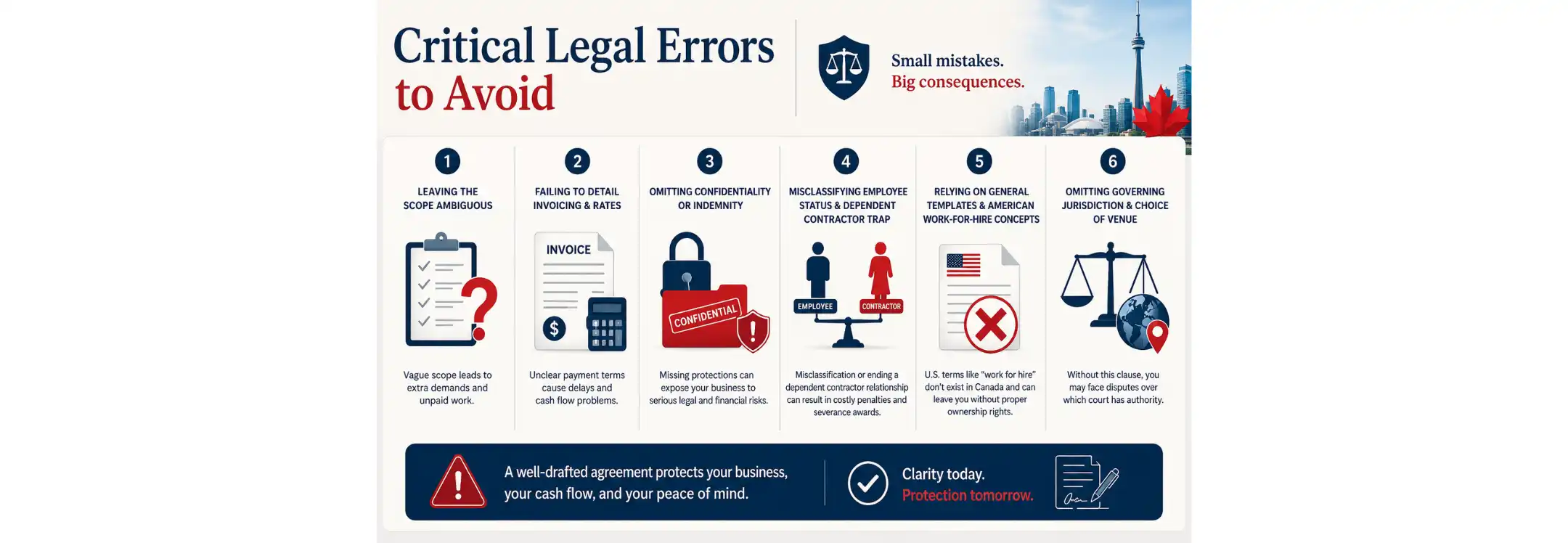
Leaving the Scope Ambiguous
Using general descriptions for the work required often leads to extra demands and unpaid labor. The contract must be highly specific, outlining exactly what is expected from the contractor. This clarity protects both sides from unexpected project changes.
Failing to Detail Invoicing and Rates
Unclear payment details are a frequent source of project delays. If the contract does not specify payment deadlines or invoicing formats, cash flow issues can occur. It is essential to describe the exact payment process clearly.
Omitting Confidentiality or Indemnity Provisions
Leaving out protective terms exposes a company to dangerous risks. Without confidentiality rules, a contractor could share private business methods with competitors. Without indemnity, a client might face huge legal bills due to a contractor's errors.
Misclassifying Employee Status and the Dependent Contractor Trap
Misclassification is a highly expensive error for Canadian companies. The Canada Revenue Agency evaluates relationships using Guide RC0 to see if they meet employee status. Additionally, Canadian common law identifies a category known as dependent contractors. These are workers who are self-employed but rely economically on a single client.
If a client terminates a long-term dependent contractor, the courts can award the worker significant severance pay. In some cases, courts awarded long-term dependent contractors up to twenty-six months of compensation. The dependent contractor analysis evaluates the entire history of the working relationship.
Relying on General Templates and American Work-for-Hire Concepts
Many businesses download generic templates online, which often contain American legal terms. Concepts like work for hire do not exist under Canadian copyright law. Using these foreign terms leaves the client without proper ownership of the creative work.
Omitting Governing Jurisdiction and Choice of Venue
Forgetting to state the governing law can create major headaches if a dispute goes to court. Without this clause, the parties may spend months arguing over which provincial court has the authority.
Walkthrough of Generating an Agreement with Ziji Legal Forms
Using a specialized online platform simplifies the drafting process and ensures all necessary legal protections are included.
1. Select Independent Contractor Agreement Template
2. Add service specifications
The business enters the precise details of the project, including scope of work, expected deliverables, and operational milestones.
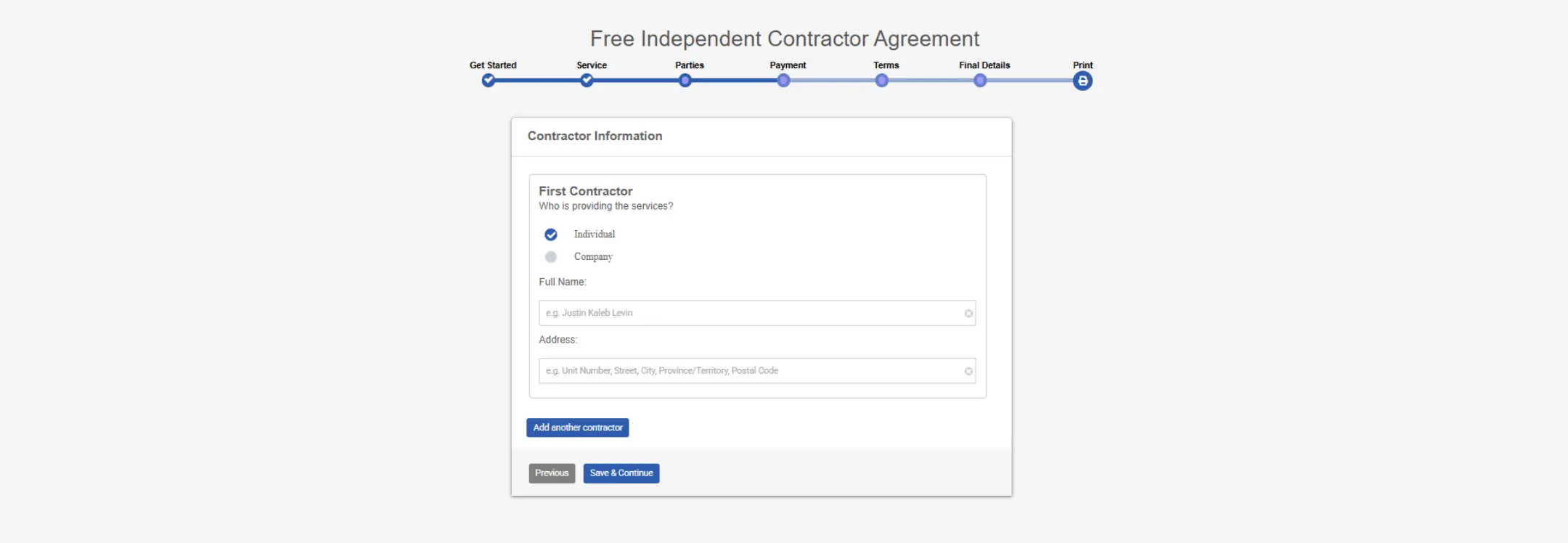
3. Add party details
Enter the legal names, business registration details, and tax information for both parties.
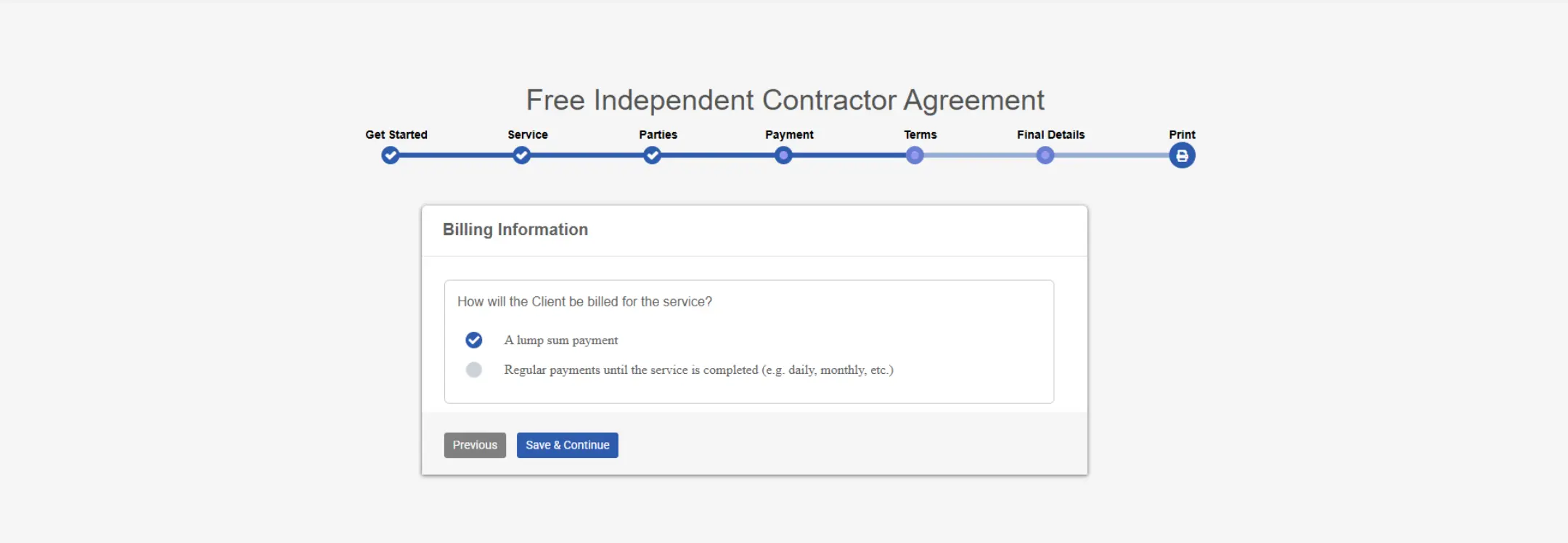
4. Define Payment Terms
Select the compensation structure, payment schedule, and invoicing requirements for the agreement.
5. Examine and execute the document
Both parties conduct a final review of the completed contract and sign it digitally to establish a binding legal relationship.
Benefits of Using Ziji Legal Forms for Contractor Agreements
Ziji Legal Forms is a Canadian-owned business that specializes in accessible, professional, and compliant templates. The platform provides do-it-yourself legal documents tailored to meet Canadian federal and provincial regulations. This makes it highly straightforward for businesses to secure their services without paying expensive lawyer fees.
By utilizing this service, companies can draft an Online Independent Contractor Agreement that includes copyright transfers and moral rights waivers. The platform is constantly updated to reflect changes in provincial employment and contract laws. This ongoing compliance helps protect businesses from worker misclassification and intellectual property loss.
Comprehensive Pre-Signing Review Checklist
Before signing the contract, conducting a final review ensures that no critical details have been overlooked.
Correct Identification of All Parties
The names, corporate structures, and addresses of both parties must be verified to ensure the agreement is enforceable.
Payment Details Verification
The billing rates, payment deadlines, and invoicing instructions must be explicitly stated to prevent late payments.
Integration of Vital Protective Covenants
The document must contain strong confidentiality, intellectual property assignment, and indemnification clauses.
Elimination of Contract Ambiguities
The terms must be clear, with no conflicting statements that could suggest an employment relationship exists.
Confirming Alignment with Canadian Laws
The agreement must comply with the provincial laws of the chosen jurisdiction and avoid American legal jargon.
Confirmation of Mutual Agreement
Both parties must review the final draft to confirm that it accurately reflects their shared intent.
Proper Execution of Signatures
The contract must be signed and dated by authorized representatives of both parties to make it binding.
Concluding Remarks
Establishing a solid legal foundation with an Independent Contractor Agreement is a crucial step for Canadian businesses. By clearly outlining project expectations, intellectual property rights, and payment structures, both parties can work with total confidence. Failing to use a tailored agreement risks expensive tax audits and misclassification lawsuits under the guidelines of the Canada Revenue Agency. Fortunately, platforms like Ziji Legal Forms allow organizations to draft compliant, provincial-specific agreements in minutes. This accessible solution provides the robust legal protection necessary to safeguard corporate assets and maintain professional operational standards.
Independent Contractor Agreement FAQs
1. Why is an Independent Contractor Agreement important?
It establishes clear expectations regarding the services, payment, timelines, and responsibilities before work begins.
2. When is an Independent Contractor Agreement recommended?
It is recommended whenever services are provided by an independent contractor rather than an employee.
3. What's the difference between a contractor and an employee?
Contractors operate independently under a service contract, while employees work under an employer's direction and are protected by employment legislation.
4. Are verbal Independent Contractor Agreements sufficient?
While they may be enforceable in some cases, a written agreement provides much stronger legal protection.
5. Can both parties revise the agreement?
Yes. The agreement can be amended at any time if both parties approve the changes in writing.
6. In which jurisdictions can I use the Ziji Legal Forms Independent Contractor Agreement?
The Ziji Legal Forms Independent Contractor Agreement is designed for use across all supported Canadian provinces and territories.
Author
Mandar Sonavane
|
Legal Content Writer at Ziji Legal Forms Inc.
Symbiosis International University
Mandar is a legal content writer specializing in the development of clear, practical, and easy-to-understand legal resources. With a strong focus on legal research, content creation, and plain-language writing, he works closely with our legal professionals to ensure that legal documents and educational materials are accurate, accessible, and user-friendly. At Ziji Legal Forms Inc., Mandar is responsible for researching legal topics, drafting and reviewing content, and helping transform complex legal concepts into straightforward guidance that empowers individuals and businesses to confidently navigate their legal needs.
Reviewed By
Histon Shek
|
General Counsel and Co-Founder at Ziji Legal Forms Inc.
University of Alberta
Histon Shek was called to the Alberta Bar in 2006. He holds a BA in Sociology and Philosophy and an LLB from the University of Alberta. As co-founder of Ziji Legal Forms Inc., he focuses on making legal documents accessible and affordable, overseeing legal integrity and content development.








 Canada
 United States