TL;DR- Worker status is determined by the actual nature of the daily relationship rather than the title or label used in a written contract.
- Key factors for classification include the degree of control, ownership of tools, the chance of profit, and the personal risk of financial loss.
- Independent contractors handle their own tax remittances and lack access to most statutory protections like minimum wage or overtime pay.
- A third category known as dependent contractors may be entitled to reasonable notice of termination despite their contractor status.
- Step-by-step guide on how to create a custom independent contractor agreement using Ziji Legal Forms.
The determination of whether a worker is an employee or an independent contractor remains one of the most significant legal challenges for businesses operating within the Canadian landscape. This distinction carries profound implications for taxation, statutory benefits, and overall legal liability. As the modern workplace evolves through the rise of digital platforms and remote work, Canadian regulatory bodies have intensified their scrutiny of these professional relationships. Misclassification is no longer viewed as a simple administrative error but as a serious breach of labor standards that can result in substantial financial penalties and retroactive costs.
Introduction: Why the Classification Matters
In Canada, the legal framework governing the workplace is built upon a fundamental division between employees and self employed individuals. This classification serves as the gateway to a wide array of rights and responsibilities. For the worker, being an employee means access to a safety net of protections including employment insurance, pension contributions, and workplace injury coverage. For the business, the classification determines the complexity of payroll operations and the extent of their legal obligations under various provincial and federal statutes.
The Rising Risk of Misclassification
Government agencies like the Canada Revenue Agency and provincial ministries of labor are increasingly vigilant in identifying instances where workers are wrongly treated as independent contractors. This practice, often referred to as misclassification, can deprive workers of essential rights such as vacation pay and statutory holiday entitlements. When a business is found to have misclassified its workforce, the financial consequences are often severe and can threaten the viability of the organization.
Financial and Administrative Burdens
Beyond the threat of legal penalties, the classification impacts the daily administrative workflow of a business. Employers are required to manage payroll deductions for income tax, Canada Pension Plan contributions, and Employment Insurance premiums for every employee. These tasks require significant resources and software integration. Conversely, while contractors reduce this immediate burden, they introduce risks related to contract enforcement and the potential for the Canada Revenue Agency to reassess the relationship years later.
What Is an Employment Contract?
An employment contract, legally referred to as a contract of service, establishes a relationship where one individual performs work under the direction and control of another. In this arrangement, the employee becomes an integral part of the employer's business. The worker provides their labor in exchange for a set wage or salary, and the relationship is generally characterized by continuity and mutual loyalty.
The Principle of Subordination
The hallmark of a contract of service is the concept of subordination. This means the employer has the authority to dictate not only the final result of the work but also the specific methods used to achieve it. Employees are expected to follow company policies, adhere to set working hours, and report to a supervisor. This level of oversight is a primary indicator that an employment relationship exists regardless of whether a written agreement calls the worker a contractor.
Integration into the Business
Integration refers to how closely the worker's activities are tied to the core operations of the company. If the business cannot function without the tasks performed by the individual, or if the individual is visually represented as part of the organization through uniforms or corporate email addresses, they are likely an employee. This factor looks at the total relationship from the perspective of a reasonable outside observer to determine the true nature of the bond.
Continuity and Exclusivity
Employment relationships in Canada are typically indefinite, meaning they continue until one party decides to end the arrangement. Employees generally work for one employer at a time and are often restricted from working for competitors. This ongoing commitment allows for long term career growth and the development of internal company culture, which is a key strategic advantage for many businesses.
Essential Components of Employment Agreements
A well drafted employment agreement must satisfy both common law requirements and provincial or federal labor standards. These documents serve to protect the interests of both parties by clearly defining the terms of the relationship from the first day of work. Any term in a contract that attempts to provide less than the minimum standards set by the law is considered void and unenforceable.
Detailed Compensation and Benefits
The agreement should explicitly state the salary or hourly rate and the frequency of payments. It must also outline eligibility for any discretionary or non discretionary bonuses, commissions, and group benefits like health and dental plans. Clear language regarding these financial aspects prevents misunderstandings and potential claims for unpaid wages later on.
Job Descriptions and Expectations
A clear and comprehensive job description is vital for setting performance standards. The contract should define the role, the specific duties involved, and the reporting structure within the company. This provides the employer with a legal basis for performance management and helps the employee understand their responsibilities from the outset.
Termination and Notice Periods
The termination clause is perhaps the most critical section of a Canadian employment contract. It must clearly define the notice or pay in lieu of notice the employee will receive if they are dismissed without cause. Recent court decisions in Canada have made it clear that these clauses must be drafted with extreme precision to ensure they do not violate statutory minimums. If a termination clause is found to be invalid, the employer may be liable for much higher common law notice periods.
Vacation and Leave Entitlements
Employment agreements must address vacation time and vacation pay in accordance with the applicable labor standards. They should also outline the process for taking other types of leave, such as sick days, bereavement leave, and statutory holidays. Providing clarity on these entitlements ensures that the business remains compliant with the law while providing employees with the time off they are entitled to.
What Is an Independent Contractor Agreement?
An independent contractor agreement, or a contract for services, represents a business to business transaction where one party provides specific services to another. The contractor is an autonomous entity that operates on their own account and assumes the financial risks of their enterprise. They are not integrated into the hiring company’s staff and generally maintain their own tools, schedule, and methods for completing the work.
Entrepreneurial Independence
The core of a contractor relationship is the lack of subordination. The client specifies the desired end result, but the contractor decides how to achieve that result. This independence allows the contractor to serve multiple clients simultaneously and manage their own business presence in the market. Contractors are viewed as professional experts who do not require the same level of training or supervision as an employee.
Financial Risk and Opportunity for Profit
Unlike employees, independent contractors face the possibility of a financial loss if their expenses exceed their revenue. They are responsible for their own overhead, including office space, professional insurance, and specialized equipment. Conversely, they have the opportunity to increase their profit through efficient work processes, negotiating higher fees, and taking on additional projects. This profit and loss factor is a primary indicator used by the Canada Revenue Agency to validate contractor status.
Project Based Engagement
Contractor agreements are usually tied to specific deliverables or a defined period of time. Once the project is complete or the contract term expires, the relationship naturally ends without the same notice requirements found in employment law. This provides businesses with the flexibility to access niche skills for specialized tasks without the long term financial commitment of a permanent hire.
Essential Components of Independent Contractor Agreements
Because contractors are not covered by most labor standards, the written agreement is the primary source of their rights and obligations. A robust contract must clearly define the boundaries of the relationship to protect both the business and the contractor from future disputes. It is essential that the language in the contract reflects the actual autonomy of the worker.
Detailed Statement of Work
The agreement must include a specific description of the services to be provided and the expected deliverables. This prevents scope creep and ensures that the contractor is not treated as a general employee who can be assigned any task. Clear milestones and performance standards help manage expectations and provide a basis for payment.
Invoicing and Payment Terms
Contractors are typically paid upon the submission of an invoice after completing certain tasks or reaching specific milestones. The agreement should specify the rate of pay, the invoicing schedule, and the expected timeframe for payment. It is also important to clarify whether the contractor is responsible for charging and remitting Goods and Services Tax or Harmonized Sales Tax.
Intellectual Property Ownership
A vital component of a contractor agreement is the intellectual property clause. Since a contractor is an outside business, they may technically own the rights to the work they create unless the contract explicitly transfers those rights to the client. The agreement should state that any work products, software, or creative materials developed during the engagement become the sole property of the hiring company upon payment.
Confidentiality and Non Solicitation
To protect the business's sensitive information, the contract must include strong confidentiality provisions. Non solicitation clauses are also common, preventing the contractor from poaching the company's employees or clients for a set period after the contract ends. These protections are essential for maintaining the competitive advantage of the hiring organization while working with outside experts.
Termination for Convenience
Most contractor agreements include a clause allowing either party to end the relationship with a set amount of notice, such as 30 days, for any reason. This provides the flexibility that is the hallmark of the contractor relationship. Unlike employment, ending a contractor agreement for convenience does not typically trigger severance obligations unless specifically negotiated in the contract.
Important Keywords: Employment Agreement vs Independent Contractor Agreement
When analyzing an employment agreement vs independent contractor agreement, it is clear that they represent two different legal philosophies. An employment agreement template focuses on the integration of the worker into the company culture and the provision of a stable wage. In contrast, an independent contractor agreement template focuses on the results of the work and the independence of the service provider.
The Value of an Independent Contractor Agreement Canada
An independent contractor agreement Canada is designed to comply with specific national standards, such as the tests used by the Canada Revenue Agency. This includes language that emphasizes the contractor's right to hire subcontractors and their responsibility for their own taxes. Using a tailored Canadian template ensures that the business is not inadvertently creating an employment relationship that could lead to tax reassessments.
Benefits of an Employment Agreement Canada
Similarly, an employment agreement Canada must address specific national and provincial requirements for notice and benefits. These documents are essential for managing the long term relationship with permanent staff and ensuring that all statutory obligations are met. A well drafted employment agreement helps reduce the risk of wrongful dismissal claims by setting clear expectations for termination from the start.
Online Tools and Accessibility
The availability of an online independent contractor agreement and an online employment agreement has made it easier for small businesses to access professional legal documentation. These tools often provide guided workflows that help users choose the right terms for their specific situation. By using these modern platforms, businesses can ensure that their contracts are consistent and legally sound without the high cost of traditional legal consultations.
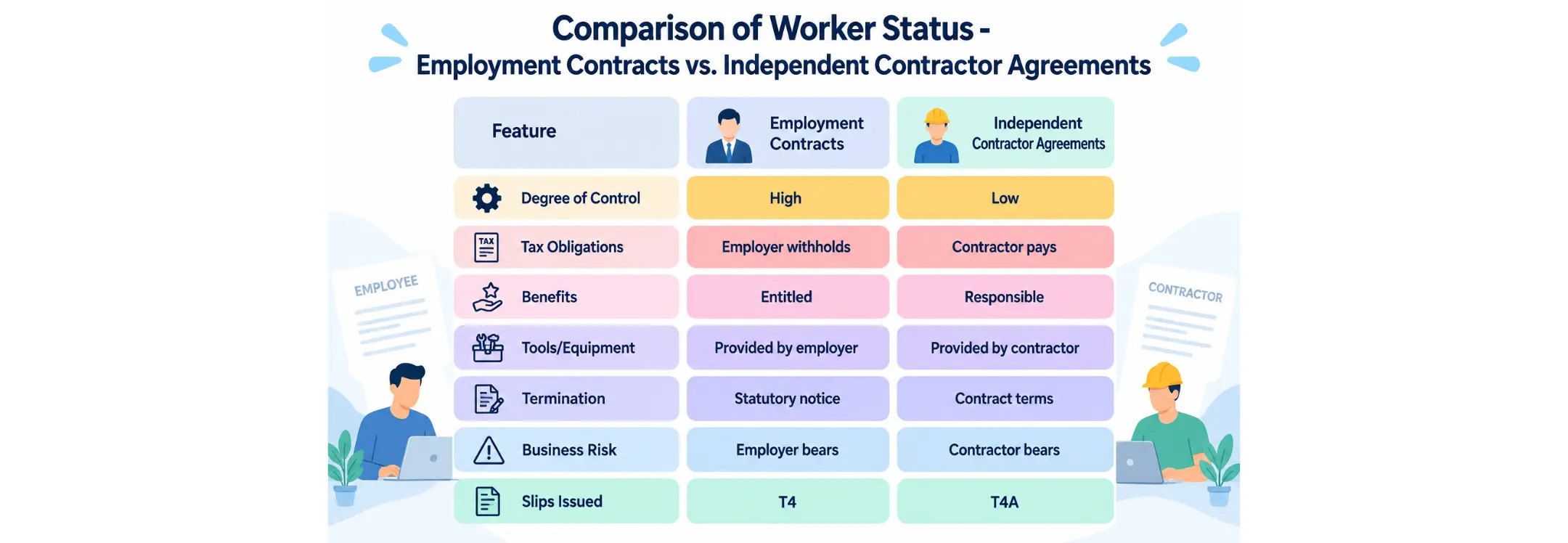
Comparison of Worker Status
Control and Supervision
Control remains the most significant factor in any worker classification audit in Canada. If the business has the right to direct the worker's activities on a day to day basis, the worker is almost certainly an employee. This includes setting the worker's schedule, requiring them to work at a specific location, and providing detailed instructions on how tasks should be performed.
Autonomy for Contractors
A true independent contractor should have the freedom to organize their own work and decide which tasks to prioritize. They are hired for their expertise and should not require constant supervision or training from the client. If a client begins to manage the contractor's workflow as they would an employee's, they risk a legal finding that the relationship has changed status.
Reporting Structures
Employees are integrated into a company's internal reporting structure and often participate in performance reviews and team meetings. Independent contractors should maintain a separate business presence and only communicate with the client regarding project deliverables and milestones. Excessive involvement in internal company meetings or social events can blur the lines of classification.
Tax and Benefits
The tax treatment of workers is a primary concern for the Canada Revenue Agency. Employers must deduct income tax, Canada Pension Plan contributions, and Employment Insurance premiums from an employee's pay and remit them to the government. They are also responsible for the employer's portion of these contributions, which adds to the total cost of hiring.
Contractor Self Remittance
Independent contractors receive the gross amount of their invoice and are responsible for managing their own tax filings. They must pay both the employer and employee portions of Canada Pension Plan contributions when they file their annual tax return. Contractors are also responsible for collecting and remitting sales taxes if they meet the registration thresholds set by the government.
Access to Protections
Employees have a legal right to various protections under the Employment Standards Act, such as minimum wage and overtime pay. They also have access to workplace injury compensation and employment insurance benefits if they are laid off. Independent contractors generally lack these protections and must fund their own private insurance and retirement savings.
Legal Protections and Rights
The Canadian legal system provides a robust framework for employee rights that cannot be waived through a contract. These include protection from discrimination and harassment under human rights codes and the right to a safe working environment under occupational health and safety laws. Employers who fail to respect these rights face significant legal liability and reputational damage.
Contractor Rights are Contractual
Independent contractors have very few statutory rights and must rely on the specific terms of their written agreement for protection. If a client fails to pay an invoice, the contractor's primary recourse is to sue for breach of contract in civil court. This makes the drafting of a clear and enforceable agreement even more vital for contractors than for employees.
Regulatory Oversight
Government agencies like labor boards and employment standards officers are available to help employees resolve disputes over pay and working conditions. These services are usually free for the worker and can result in orders for the employer to pay back wages and penalties. Independent contractors do not have access to these administrative bodies and must bear the costs of any legal disputes they initiate.
Duration and Commitment
Employment in Canada is built on the expectation of a long term relationship. Most employees are hired on an indefinite basis and remain with the company for several years. This commitment allows for the building of deep institutional knowledge and strong professional bonds within the organization.
Flexibility for Contractors
Independent contractors provide businesses with the ability to scale their operations quickly. They are often brought in for short term needs or to provide specialized skills that are not required on a permanent basis. This flexibility is a major advantage for startups and companies with seasonal or project based workloads.
The Risk of Long Term Contracting
When a contractor relationship lasts for several years and involves full time work for a single client, the legal risk increases. Over time, these workers often become indistinguishable from employees in their daily activities. Canadian courts and the Canada Revenue Agency look at the entire history of the relationship to determine if the worker should have been classified as an employee from the start.
Equipment and Resources
The provision of tools and equipment is a practical indicator of worker status. Employers generally supply everything an employee needs to perform their duties, including office space, computers, and specialized software. The employer also takes on the responsibility for the maintenance and insurance of these assets.
Contractor Tool Ownership
Independent contractors are expected to provide their own equipment and workspace at their own expense. This investment in the tools of the trade is a hallmark of a genuine business operation. If a worker relies entirely on the client's resources to do the job, it strongly suggests an employment relationship exists.
Operating Expenses
Contractors are also responsible for all their overhead and operating costs, such as marketing, accounting, and professional development. Employees do not carry these burdens; if they incur expenses in the course of their work, they are usually reimbursed by the employer. The ability of a contractor to manage these costs effectively is what allows them to generate a profit.
Termination of Employment Contracts vs Contractor Agreements
Ending an employment relationship in Canada is a complex process that must be handled with care. Unless there is just cause for dismissal, employees are entitled to reasonable notice or pay in lieu of notice. This notice period can be significant for long term employees and is designed to give them time to find new employment.
Independent contractor agreements can usually be terminated according to the terms specified in the contract. This typically involves a set notice period, such as two weeks or one month, without the need for additional severance payments. However, if the termination is handled improperly, the contractor may sue for breach of contract or argue they were actually an employee or dependent contractor.
Resolving Professional Conflicts
Disputes with employees often involve administrative tribunals that are designed to be faster and less formal than the court system. Contractor disputes are handled through standard civil litigation or alternative dispute resolution methods like mediation and arbitration. Clear dispute resolution clauses in a contractor agreement can save both parties time and money if a disagreement arises over payments or deliverables.
When to Use Each Document Type
The choice between an employment contract and a contractor agreement should be based on the long term goals of the business and the nature of the tasks involved. Businesses should assess whether they need a committed team member who will grow with the company or a specialized expert for a specific outcome.
Using an Employment Contract
Employment contracts are the correct choice for permanent roles that require full integration into the company's daily operations. If the worker needs to follow internal management structures and be available for ongoing, indefinite work, they should be hired as an employee. This ensures that the business maintains the necessary control over its processes and remains compliant with all national labor standards.
Using an Independent Contractor Agreement
Independent contractor agreements should be used for project based work where the business needs a specific result from a specialist. This is common for creative services, IT projects, and high level consulting. Using a contractor agreement in these cases provides the business with flexibility and limits long term liabilities while allowing them to access the best talent in the market.
Benefits of Creating Employment and Independent Contractor Agreements with Professional Tools like Ziji Legal Forms
Platforms like Ziji Legal Forms offer significant advantages by providing legally vetted language and guided workflows. They help businesses capture all the necessary details, from payment terms to intellectual property rights, in a clear and organized manner. This professionalism reinforces the legitimacy of the worker's status and provides a strong defense in the event of an audit.
Customization, Consistency, and Reducing Risk
One of the greatest benefits of using professional tools is the ability to customize agreements to fit specific roles while maintaining consistency across the organization. This helps ensure that all workers are treated fairly and that the company's legal protections are uniform. By reducing the chance of poorly worded or contradictory clauses, businesses can significantly lower their risk of facing costly legal challenges.
Convenience and Ongoing Compliance
Labor laws in Canada are not static and can change with new legislation or court decisions, such as those seen in 2024 and 2025. Professional document platforms stay updated with these changes so that businesses can remain compliant without having to constantly monitor legal updates. This convenience allows business owners to focus on their core operations while having peace of mind that their professional agreements are current and valid..
Creating Agreements Easily in 5 Steps with Ziji Legal Forms
Modern technology has simplified the process of generating high quality legal documents for the Canadian market. Ziji Legal Forms provides a user friendly platform that allows business owners to create robust contracts in just a few minutes. By following these five structured steps, you can ensure that your professional relationships are grounded in clear and compliant documentation.
1. Choose template
2. Add Services Information
Clearly define the scope of work and the specific deliverables that the worker is expected to provide during the engagement.
3. Add Parties Information
Enter the full legal names and contact details for both the hiring company and the individual or business being contracted.
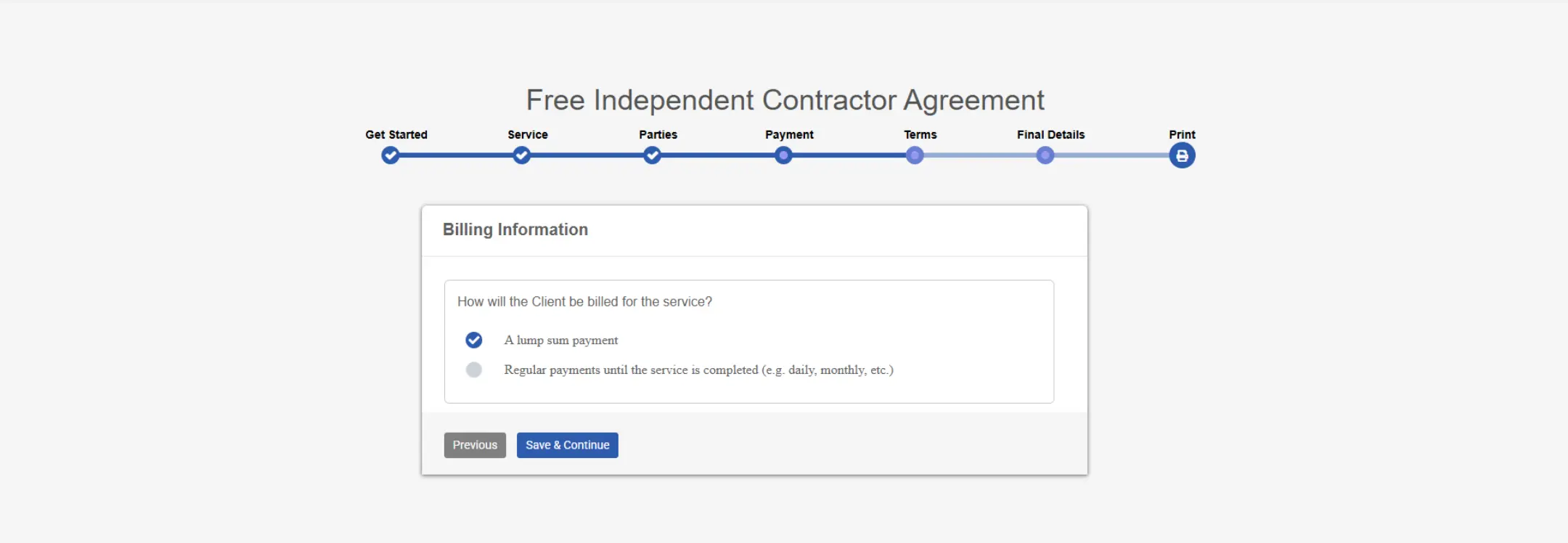
4. Add Payment and Terms Information
Detail the compensation structure and the duration of the relationship to ensure both parties have a clear financial understanding.
5. Preview and Print
Review the completed document for accuracy and clarity before generating a professional version that is ready for signing and filing.
Legal Compliance and Risk Management
Risk management in worker classification requires an ongoing commitment to monitoring and documentation. Businesses must ensure that the reality of the working relationship matches the terms of the written agreement. If a contractor's role changes over time to include more supervision or integration, the agreement must be updated or the worker's status must be formally reassessed.
Avoiding the Dependent Contractor Trap
A unique challenge in Canada is the category of the dependent contractor. These are individuals who are technically contractors but work exclusively or nearly exclusively for one client. Canadian courts have ruled that these workers are entitled to reasonable notice of termination because of their economic dependence on the hiring company. Businesses must be aware of this middle category and budget for potential notice obligations when working with long term contractors.
The Role of Audits and Rulings
Proactive internal audits can help identify potential misclassification risks before they attract the attention of the Canada Revenue Agency. If a business is unsure of a worker's status, they can request a formal ruling from the government to gain a definitive answer. While this involves exposing the relationship to scrutiny, it is often better to resolve the issue early than to face years of back taxes and penalties later.
Protecting the Bottom Line
The financial impact of a successful misclassification claim can be devastating for a small business. This includes paying both the employer and employee portions of Canada Pension Plan and Employment Insurance, plus interest and penalties that can reach as high as 20 percent of the original amount. Investing in high quality legal documentation and professional advice is a small price to pay to avoid these catastrophic costs.
Conclusion
Correctly classifying workers as either employees or independent contractors is a vital task for any business operating in Canada. This decision impacts everything from tax remittances to the legal rights of the worker and the long term liabilities of the company. By understanding the key indicators used by the Canada Revenue Agency and utilizing professional tools like Ziji Legal Forms, businesses can manage their workforce effectively and with confidence.
Independent Contractor Agreement FAQs
1. What does an Independent Contractor Agreement do?
An Independent Contractor Agreement defines the services to be provided, payment terms, timelines, and the responsibilities of both the contractor and the client.
2. Who should use an Independent Contractor Agreement?
Businesses and individuals hiring freelancers, consultants, tradespeople, or other independent service providers should use this agreement.
3. Is an independent contractor considered an employee?
No. Independent contractors generally control how they perform their work and are not treated as employees under employment legislation.
4. Why should an Independent Contractor Agreement be in writing?
A written agreement creates a clear record of each party's obligations and helps prevent misunderstandings or disputes.
5. Can the contract terms be updated?
Yes. The contractor and client may amend the agreement if both parties agree in writing.
6. Where can the Ziji Legal Forms Independent Contractor Agreement be used?
The Ziji Legal Forms Independent Contractor Agreement is available for use throughout the supported Canadian jurisdictions.
Author
Mandar Sonavane
|
Legal Content Writer at Ziji Legal Forms Inc.
Symbiosis International University
Mandar is a legal content writer specializing in the development of clear, practical, and easy-to-understand legal resources. With a strong focus on legal research, content creation, and plain-language writing, he works closely with our legal professionals to ensure that legal documents and educational materials are accurate, accessible, and user-friendly. At Ziji Legal Forms Inc., Mandar is responsible for researching legal topics, drafting and reviewing content, and helping transform complex legal concepts into straightforward guidance that empowers individuals and businesses to confidently navigate their legal needs.
Reviewed By
Histon Shek
|
General Counsel and Co-Founder at Ziji Legal Forms Inc.
University of Alberta
Histon Shek was called to the Alberta Bar in 2006. He holds a BA in Sociology and Philosophy and an LLB from the University of Alberta. As co-founder of Ziji Legal Forms Inc., he focuses on making legal documents accessible and affordable, overseeing legal integrity and content development.








 Canada
 United States