TL;DR- Canadian laws regulate non-permanent work agreements strictly to protect staff.
- A Temporary Employment Contract provides schedule flexibility for changing needs.
- A Fixed Term Employment Contract offers stability but brings payout risks.
- Repeated contract renewals can turn short jobs into permanent roles.
- Build legally valid Employment Contracts with Ziji Legal Forms.
Introduction: Flexibility in Canadian Staffing Arrangements
Modern firms need flexible work options. They use non-permanent staff to balance budgets. This manages heavy workloads without high costs. But employers must know Canadian contract laws. The wrong setup brings legal penalties. It also creates big financial risks. This report explains temporary and fixed agreements. It helps firms make safe choices.
What Is a Temporary Employment Contract
A Temporary Employment Contract is a flexible tool. It helps solve short-term staffing needs. It lets firms hire workers quickly. This requires no long-term commitment.
Definition and Purpose
This contract creates a brief work relationship. There is no promise of permanent status. The main goal is to meet immediate labor gaps. It keeps scheduling options open for the firm. It helps businesses stay nimble. These agreements must follow provincial rules of fairness.
Common Temporary Work Situations
Firms use temporary agreements for shifting roles. Standard setups include extra help for holiday sales. They also use them for brief sales projects. This contract works well when a worker is sick. It keeps daily operations running smoothly.
Typical Durations and Renewal Rules
Temporary work can last days or several months. But employers must extend them carefully. Renewing these agreements too often brings legal risks. A court may rule the job is permanent. The agreement should state there is no expectation of ongoing work.
What Is a Fixed Term Employment Contract
A Fixed Term Employment Contract is an agreement with a specific duration. Both parties agree on the precise end date. This agreement creates a structured, time-limited work relationship.
Distinguishing Fixed Term from Temporary
Both structures are non-permanent. But they differ in commitment levels. A temporary contract is highly flexible. It can end with brief notice. A Fixed Term Employment Contract guarantees work for the whole period. Ending a fixed plan early can trigger heavy payout costs.
Typical Use Cases for Fixed Term Contracts
Firms use these agreements for predictable, time-limited needs. It is the best choice for covering parental leaves. It is also ideal for specialized projects with clear end dates. Grant-funded positions rely on this structure. It matches project budgets perfectly.
Full-Time and Part-Time Variations
Fixed-term agreements work for full-time or part-time hours. The defining feature is always the specific end date. Part-time fixed-term staff enjoy the same rights as full-time staff. These include vacation pay and holiday compensation. Employers must define all hours clearly in the contract template.
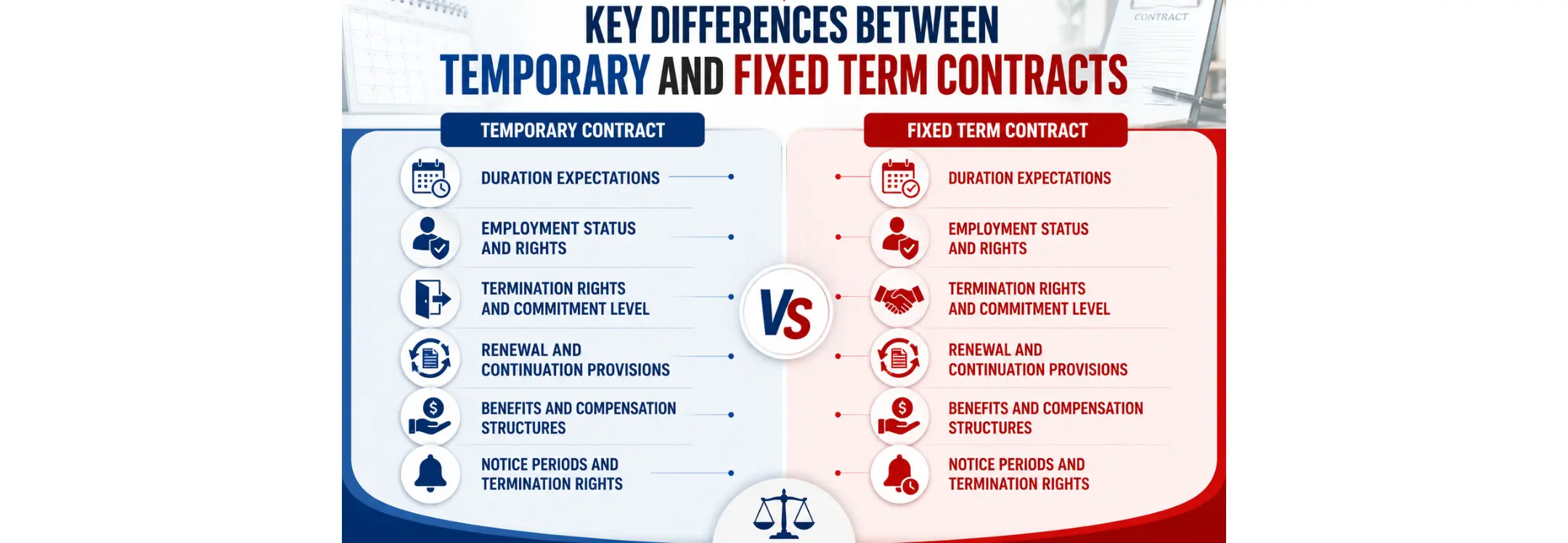
Key Differences Between Temporary and Fixed Term Contracts
Understanding the structural differences is vital for compliance. It helps employers control operational risks and budgets.
Duration Expectations
A temporary plan is open-ended within a short window. It adapts to changing weekly volumes. A fixed-term agreement has a strictly defined start and end date. There is no doubt about when the relationship ends. This structure provides excellent certainty for project planning.
Employment Status and Rights
In Canada, all short-term staff receive standard workplace rights. This includes minimum wage and overtime pay. However, fixed-term workers expect continuous work during the term. Temporary workers understand that schedules can change based on daily demand.
Termination Rights and Commitment Level
The legal commitment is much higher in a fixed-term contract. If an employer ends it early without cause, the firm must pay the remaining value. This means paying all wages for the rest of the term. Temporary contracts allow for a quicker exit with simple notice.
Renewal and Continuation Provisions
Contract renewals are a major source of legal risk. If an employee works past the end date, the contract becomes indefinite. This triggers standard common law notice requirements. For temporary contracts, repeated extensions also lead to a permanent finding.
Benefits and Compensation Structures
Compensation follows provincial standards, but benefits vary. Temporary staff rarely receive extended health benefits. They usually get vacation pay as a percentage added to each check. Fixed-term staff on longer agreements may negotiate standard health benefits. The contract must state these terms clearly.
Notice Periods and Termination Rights
Notice rules differ significantly when ending these agreements early. Temporary plans follow provincial standards based on active service. Fixed-term contracts do not require notice at the scheduled end date. But early termination requires a highly specific clause to limit payout liabilities.
When Employers Should Use a Temporary Contract
Selecting a temporary agreement depends on the predictability of the business. This model is best for handling sudden changes in operational demand.
Seasonal Work and High-Demand Periods
Temporary agreements are perfect for seasonal industries. Retail and hospitality firms benefit from this model during busy months. It allows businesses to onboard staff quickly to handle the rush. Once the peak season ends, the relationship concludes with no ongoing duties.
Event Staffing and Campaign-Based Work
If a business runs short-term events, temporary contracts are highly practical. These roles are tied directly to brief promotional campaigns. Staff perform specific tasks for the duration of the activity. This approach keeps operating costs low once the event finishes.
Short-Term Administrative Support
Sudden increases in office tasks often require extra help. A temporary contract lets firms bring in support without a permanent salary. This is effective for entering data or sorting backlogged files. It resolves administrative bottlenecks quickly.
When Employers Should Use a Fixed Term Contract
A fixed-term agreement is the best choice when a business needs stability. It ensures that a critical role is filled for a set period.
Covering Extended Leave Periods
When a permanent worker takes parental leave, the firm must maintain continuity. A Fixed Term Employment Contract ensures the replacement worker stays for the full leave. This gives both parties clear expectations. It supports smooth operations while the regular worker is away.
Grant-Funded and Time-Limited Projects
Many organizations receive specialized funding tied to specific projects. If a firm hires staff using these funds, a fixed-term agreement is essential. It aligns the job length with the funding period. This prevents the business from facing ongoing salary liabilities.
Hiring Specialized Expertise for Defined Goals
Sometimes a business needs specialized skills to implement a new system. A fixed-term agreement lets the firm hire an expert for that exact project. This provides access to top-tier talent. It avoids the long-term cost of a permanent executive salary.
Maintaining Stability During Transitions
During corporate mergers or restructuring, firms experience periods of change. Using fixed-term agreements helps maintain operational stability. It lets employers keep essential roles filled without making permanent commitments. This supports smooth transitions and minimizes operational disruption.
Essential Clauses to Include in These Contracts
To protect a business, employers must include specific, legally binding clauses. This minimizes the risk of future legal disputes.
Job Title and Responsibilities
Every Employment Contract in Canada needs a clear description of the role. This establishes clear expectations from the first day. It prevents disputes. The description should be clear but allow for reasonable operational changes.
Start Date, End Date and Duration Certainty
To maintain the short-term status of the contract, dates must be certain. Any ambiguity can cause a court to rule that the contract is permanent. The agreement must state that work ends automatically on the set date.
Compensation and Benefits
The contract must detail the exact wage and payment schedule. It must also outline eligibility for any company benefits. If the role is eligible for overtime, specify how it is calculated. For temporary staff, state how vacation pay is handled.
Work Schedule and Location
Specify the expected hours of work and the primary work location. If the hours are variable, explain how schedules are set and shared. For remote arrangements, state the rules for working from home clearly. This supports daily productivity.
Termination and Early Exit Rules
This is the most critical clause in a Fixed Term Employment Contract. Without a valid early termination clause, ending the contract early means paying out the remaining term. The clause must state that the firm can end the job early with minimum statutory notice.
Renewal or Non-Renewal Conditions
The contract must state that there is no expectation of renewal. If a renewal is possible, outline the formal process to extend it. This prevents situations where a worker assumes they will keep working automatically.
Probation and Performance Evaluation
Include a probation period to assess if the worker fits the role. Specify the length of the probation and evaluation rules. Provincial rules regulate probation, so terms must comply with these legal limits. A clear clause lets employers end the work quickly.
Legal and Compliance Considerations
Operating a compliant business in Canada requires strict adherence to employment standards. Employers must ensure their practices align with both statutory minimums and common law rules.
Wage and Hour Law Compliance
All temporary and fixed-term workers are protected by provincial wage and hour laws. Employers must pay at least minimum wage. They must track hours accurately for overtime. Failure to comply can lead to costly legal audits.
Anti-Discrimination and Equal Treatment
Canadian human rights rules protect all staff from discrimination. Short-term staff must receive the same fair treatment as permanent staff. This includes protection from harassment and the right to reasonable accommodations.
Misclassification Risks
A common mistake is misclassifying employees as independent contractors to avoid taxes. Courts look at the true nature of the relationship, not just the label. Misclassification can result in heavy retroactive tax audits and unpaid overtime claims.
Understanding Termination Rights in Canada
Termination rights in Canada are governed by provincial statutes and common law rules. Unlike the United States, where employment is often at-will, Canadian employers must provide notice or pay. If an early termination clause is void, the employer must pay the remaining contract balance. Some provinces enforce a duty to mitigate this loss, while other provincial courts do not.
Documentation Requirements
Proper documentation is essential for defending your business against legal claims. Employers must keep accurate records of hours worked and signed agreements. All agreements must be signed before the worker begins their first day. This ensures terms are legally binding.
How to Create These Contracts Using Ziji Legal Forms
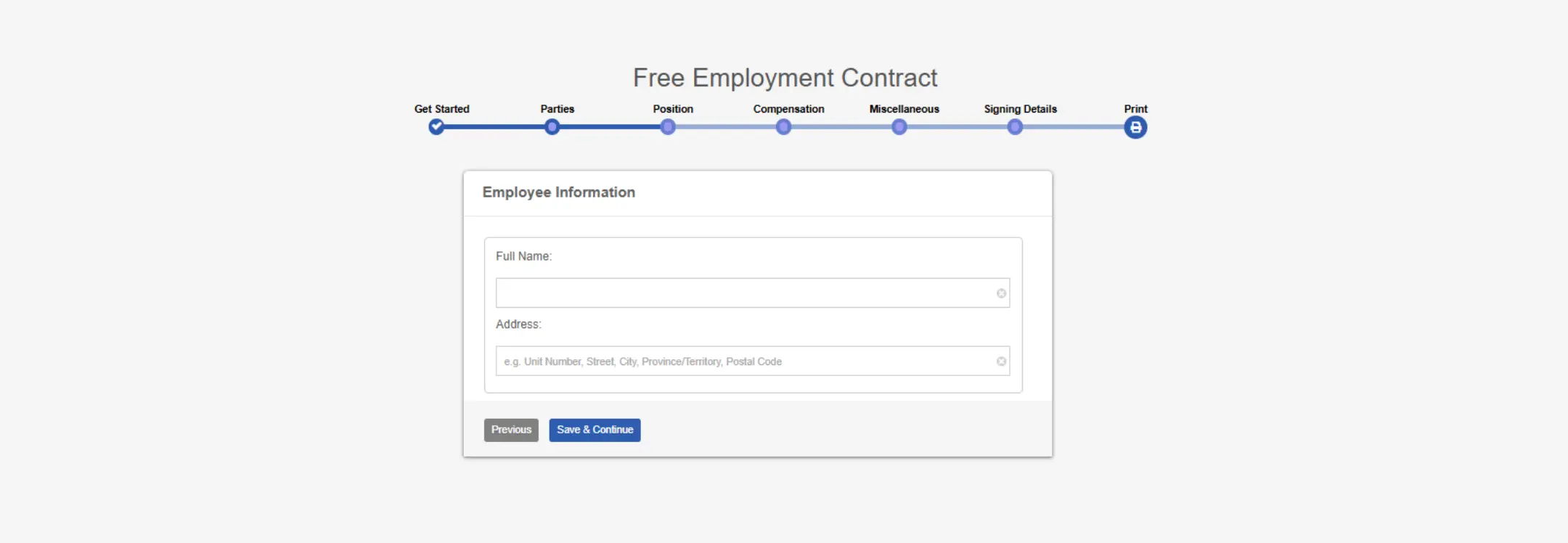
Creating a legally sound contract is simple and efficient when using professional online tools. The process takes only a few minutes to complete.
1. Choose template
2. Add Parties Details
The user enters the official legal names and contact details of both the employer and the employee.
3. Add Position Details
The user specifies the job title, responsibilities, start date, end date, and overall duration.
4. Add Compensation Details
The user inputs the wage rate, payment frequency, overtime details, and applicable vacation pay.
5. Preview and print
The user reviews the completed document online before saving, downloading, and printing the agreement.
Template Features and Customization
The templates from Ziji Legal Forms are fully customizable to meet specific staffing needs. It is possible to adjust clauses to fit temporary or fixed-term setups while ensuring compliance. The platform guides users through each step, making it easy to protect your business. This user-friendly approach reduces the need for costly legal consultations.
Conclusion: Use the Right Contract for Your Staffing Needs
Selecting the correct agreement structure is essential for managing a workforce and protecting a business. A Temporary Employment Contract provides the flexibility needed for seasonal shifts. Fixed-term plans offer stability for defined projects. Employers must ensure that every contract is clearly drafted and signed before work begins. Using a high-quality Employment Contract Canada template simplifies this process. It keeps a business compliant with provincial standards.
Employment Contract FAQs
1. Why is an Employment Contract important?
It creates a clear record of the employment terms and helps protect both employers and employees throughout the employment relationship.
2. When should I use an Employment Contract?
An Employment Contract should be used whenever you hire someone as an employee rather than as an independent contractor.
3. Can I use an Employment Contract for an independent contractor?
No. Independent contractors should generally be engaged using an Independent Contractor Agreement or Service Agreement instead.
4. What information should an Employment Contract include?
It should include details such as the employee's duties, compensation, work schedule, benefits, probation period, and other employment terms.
5. Can the terms of an Employment Contract be updated?
Yes. Both parties may revise the agreement if they mutually agree to the changes in writing.
6. In which jurisdictions can I use the Ziji Legal Forms Employment Contract?
The Ziji Legal Forms Employment Contract is designed for use across all supported Canadian provinces and territories.
Author
Mandar Sonavane
|
Legal Content Writer at Ziji Legal Forms Inc.
Symbiosis International University
Mandar is a legal content writer specializing in the development of clear, practical, and easy-to-understand legal resources. With a strong focus on legal research, content creation, and plain-language writing, he works closely with our legal professionals to ensure that legal documents and educational materials are accurate, accessible, and user-friendly. At Ziji Legal Forms Inc., Mandar is responsible for researching legal topics, drafting and reviewing content, and helping transform complex legal concepts into straightforward guidance that empowers individuals and businesses to confidently navigate their legal needs.
Reviewed By
Histon Shek
|
General Counsel and Co-Founder at Ziji Legal Forms Inc.
University of Alberta
Histon Shek was called to the Alberta Bar in 2006. He holds a BA in Sociology and Philosophy and an LLB from the University of Alberta. As co-founder of Ziji Legal Forms Inc., he focuses on making legal documents accessible and affordable, overseeing legal integrity and content development.








 Canada
 United States