TL;DR- Generic templates often fail to account for current Canadian legal standards like the Waksdale decision.
- Ambiguous job descriptions increase the risk of costly constructive dismissal claims and performance issues.
- Termination clauses must strictly follow statutory minimums or the entire agreement might be struck down.
- Confidentiality and IP ownership require specific language to protect business assets and moral rights.
- Employment standards vary by jurisdiction and require regular updates to reflect changing labor laws.Non-compete clauses are increasingly prohibited or difficult to enforce compared to non-solicitation terms.
- Contracts signed after the start of work often lack the fresh consideration needed for legal validity.
- You can use Ziji Legal Forms' Template to easily create Employment Contracts
Introduction: Why Employment Contracts Matter
The relationship between an employer and a worker is one of the most significant legal bonds in the professional world. In the Canadian context, every employment relationship is governed by a contract, whether that agreement is written down on paper or consists of verbal promises and handshakes. While oral agreements are legally recognized, they often lead to a lack of clarity that can result in expensive disputes and high stakes litigation. A well drafted written document provides a tangible record of the bargain made between the parties, reducing the reliance on memory and subjective interpretation.
Without a formal written agreement, the relationship is largely governed by the common law, which generally defaults to a highly protective stance toward the worker. Under the common law, if a relationship ends without a written notice provision, the employer must provide reasonable notice. This period of notice is determined by several factors including the age of the individual, their length of service, and the availability of similar work in the market. This can result in an obligation to pay several months or even years of salary, which is a significant financial risk for any organization.
A robust written contract allows the parties to bring certainty to these issues by defining notice periods and other critical terms from the outset. It serves as a comprehensive manual for the professional relationship, outlining expectations and protecting the legitimate interests of the business. By ensuring that every Online Emplyment Contract is clear and compliant, employers can build a foundation of trust and stability with their workforce.
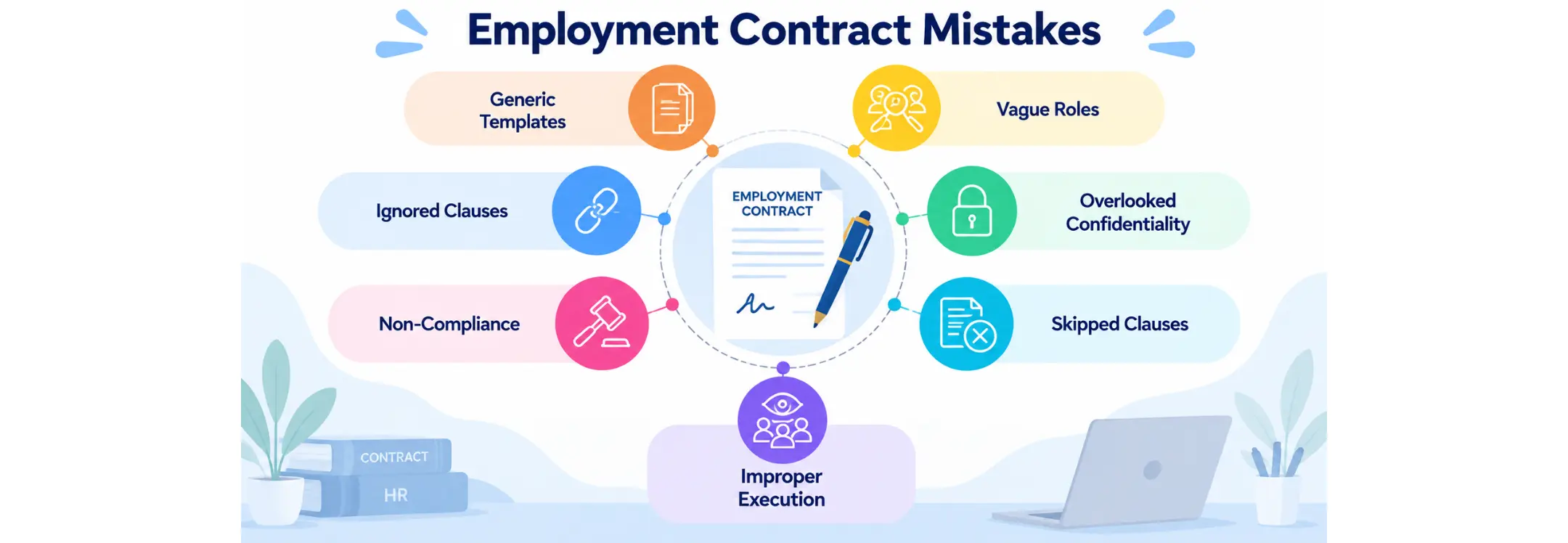
Mistake 1: Using Generic or Outdated Templates
Why One-Size-As-All Fails
The temptation to download a free template from the internet is strong for many small business owners, but this approach often invites legal disaster. Employment laws are not uniform across the globe, and a template designed for the United States or the United Kingdom will likely use concepts that have no standing in a Canadian court. For instance, the American doctrine of at-will employment, which allows for dismissal without notice for any reason, does not exist in the Canadian legal system.
Generic documents often fail to address the specific statutory requirements of the jurisdiction where the work is performed. Because employment standards are primarily provincial, a generic agreement might miss essential details about vacation pay, overtime eligibility, or holiday entitlements. If a contract uses terms like the Fair Labor Standards Act instead of the relevant local legislation, it may be viewed as a sign that the parties did not truly understand the agreement they were signing.
Consequences of Generic Templates
The legal landscape shifted dramatically following a landmark decision by the Ontario Court of Appeal known as Waksdale versus Swegon North America Inc. The court ruled that an employment agreement must be read as a whole rather than in isolated pieces. If any part of the termination section in the contract violates the minimum requirements of the law, the entire termination scheme is rendered void and unenforceable. This means that a single error in a "for cause" paragraph can destroy the protection of a "without cause" provision.
Many generic templates contain broad definitions of cause that do not align with the strict statutory standards found in Canada. While an employer might want the power to fire someone for simple performance issues without pay, the law generally requires non-trivial wilful misconduct for such a drastic step. When these clauses fail, the employer is forced to pay common law notice, which can cost tens of thousands of dollars more than the statutory minimums. A simple template error can therefore lead to a massive and unexpected financial liability.
How to Prevent This Mistake
The best way to prevent this mistake is to move away from static templates and toward a dynamic drafting process that reflects current jurisprudence. Employers should perform an annual audit of their contract forms to ensure they have been updated to account for recent court rulings. Using an Online Employment Contract tool that is specifically localized for the Canadian market is a critical step in maintaining compliance.
Precision in drafting is paramount, as any ambiguity will usually be interpreted in favor of the employee. This is known as the doctrine of contra proferentem, which places the burden of clarity on the person who wrote the document. Every Employment Contract template should be reviewed to ensure it uses the correct legal terminology and clearly defines all entitlements. By taking a proactive approach to document maintenance, businesses can ensure their agreements remain a powerful shield against legal risk.
Mistake 2: Leaving Job Roles and Responsibilities Vague
The Cost of Ambiguous Duties
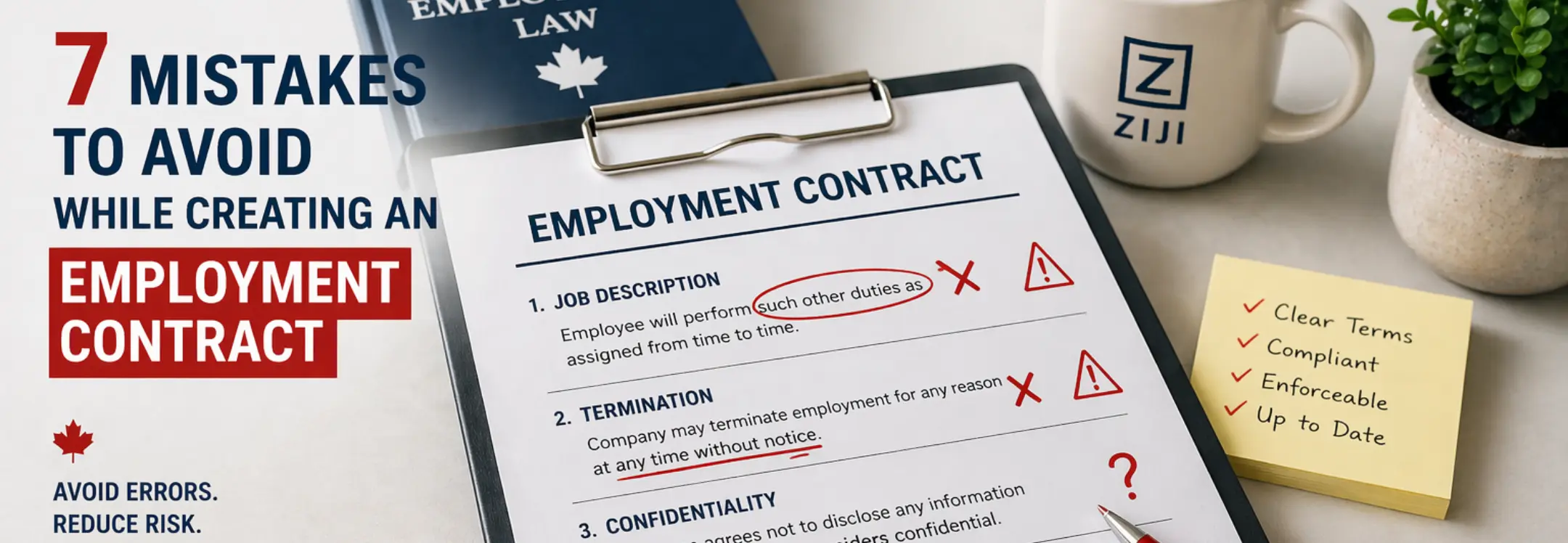
Clearly defining the job position and duties is a fundamental step when you Create Employment Contract, yet many agreements use vague language like other duties as assigned. While this might seem to offer flexibility, it often leads to unrealistic expectations and misunderstandings between the parties. When a worker is unsure of their primary responsibilities, their productivity may suffer, and the employer may find it difficult to evaluate their performance fairly.
Vague role definitions are a major trigger for constructive dismissal claims in Canada. Constructive dismissal happens when an employer unilaterally makes a significant change to a fundamental term of the contract without the consent of the worker. If the original job description was never documented, it becomes much harder for the employer to argue that a change in duties was within the scope of the original agreement. This lack of clarity can lead to a situation where a worker resigns and successfully sues for full severance.
Performance Management Problems
Effective performance management depends on the ability to point to clear, objective standards that were established at the start of the relationship. If the duties are poorly defined, any attempts to implement a Performance Improvement Plan may be viewed as arbitrary or unfair. Courts are often skeptical of performance related terminations if the employer cannot prove that the expectations were communicated effectively and reasonably.
Inconsistent feedback based on ambiguous roles can also lead to allegations of bad faith or discrimination. For example, if a worker is penalized for failing to meet targets that were never part of their written job description, they may claim they are being set up to fail. Documentation is the core of risk governance, and without a clear role definition, the organization's credibility in court is weakened. A vague role turns a standard management process into a high risk legal gamble.
Concrete Job Descriptions Protect Everyone
A detailed job description provides a baseline for both parties and helps the worker understand exactly how their success will be measured. It should include not only the daily tasks but also the reporting structure and the level of authority the individual will hold. As a business grows and a role evolves, the employer should update the written agreement to ensure it still reflects the reality of the work being done.
By documenting specific goals and requirements, the employer creates a defensible record that can be used if discipline becomes necessary. This transparency reduces the risk of the worker feeling as though their position is being slowly eroded, which is often described as death by a thousand cuts. A clear role definition ensures that the employment bargain remains intact and that both sides are working toward the same objectives.
Mistake 3: Ignoring Probation, Notice, and Termination Clauses
Legal Implications of Missing Termination Terms
One of the most frequent and costly Mistakes in Employment Contracts is the complete omission of an enforceable termination clause. Many employers assume that the statutory minimums will apply by default, but the reality is quite different. Without a valid clause that specifically limits notice entitlements, the law assumes that the worker is entitled to common law reasonable notice. This is a judge made standard that is almost always significantly higher than the bare minimums required by the government.
A missing or defective clause creates massive financial uncertainty for the business. For instance, a long term worker might be entitled to only eight weeks of notice under provincial law, but a court could award them twenty four months of pay if the contract is silent. This discrepancy can lead to settlement costs that far exceed the company's budget for restructuring or layoffs. An enforceable clause is the only way for an employer to gain predictability over these future liabilities.
What Good Termination Clauses Include
To be legally sound, a termination clause must clearly and unambiguously contract out of the common law while strictly adhering to statutory floors. It must explicitly state that the worker will receive all entitlements required by the law, including benefits continuation and vacation pay during the notice period. Many clauses are struck down simply because they mention base salary but forget to include other forms of regular pay.
Recent case law has highlighted that language giving an employer the right to terminate at any time or in its sole discretion is incredibly risky. Courts have ruled that such phrasing is misleading because the law actually prohibits termination in certain situations, such as when someone is on a protected leave. A good clause remains concise and focuses on precisely mirroring the language of the Employment Standards Act or the Canada Labour Code. Precision is the only way to avoid the cascading failures described in the Waksdale decision.
Mistake 4: Overlooking Confidentiality and IP Ownership
Business Protection Through Clear Ownership
There is a common misconception that if a company pays for research and development, it automatically owns the resulting intellectual property. While the Canadian Copyright Act does provide a default rule that works created by employees belong to the employer, this rule has many nuances and exceptions. It only applies to traditional workers under a contract of service and does not cover independent consultants or freelancers. Without a written assignment, these contractors retain the rights to their work.
Even with regular staff, relying on the statutory default can lead to messy disputes about whether a specific project was created in the course of employment. If a developer creates a valuable tool using company resources but during their free time, the ownership of that tool becomes a complex question of fact. Explicitly including IP assignment clauses when you Create Employment Contract Online removes this ambiguity and ensures that the business owns its competitive edge.
Common Ownership Wording Errors
One of the most dangerous errors in IP drafting is the failure to include a waiver of moral rights. In Canada, an author possesses moral rights to protect the integrity of their work and their right to be associated with it as the creator. These rights cannot be sold or assigned, they stay with the worker even after the copyright has been transferred. Without a written waiver, an employer might find themselves unable to modify a design or use a piece of software without the worker's permission.
Confidentiality clauses also frequently suffer from vague definitions that make them difficult to enforce. A strong agreement should clearly define what counts as a trade secret and state that the obligations of secrecy survive the end of the professional relationship. Failing to customize these terms to the specific role can leave a business vulnerable when a senior manager leaves for a direct competitor. Protecting proprietary data requires a localized approach that respects the labyrinthine rules of Canadian IP law.
Mistake 5: Failing to Comply With Local Labor Laws
The legal framework for employment in Canada is a complex patchwork of provincial and federal rules that are constantly being updated. A common mistake is for a company to use a single agreement for all its workers across the country without realizing that standards for overtime, vacation, and public holidays vary by region. For example, the rules regarding the right to disconnect or pay transparency have changed recently in several provinces, requiring immediate contract updates.
Non compliance often occurs because employers are unaware of 2024 and 2025 legislative shifts that have introduced new job protected leaves. In many places, the law now restricts an employer's ability to demand a doctor's note for short term sick leave. Agreements that have not been revised since these changes went into force may contain terms that are now illegal, exposing the business to administrative penalties and unwanted scrutiny.
Consequences of Non-Compliance
Violating the minimum standards of a jurisdiction is a serious matter that can lead to heavy financial and reputational costs. Because workers cannot contract out of their statutory rights, any term in an agreement that provides less than the legal floor is automatically void. This can trigger a government investigation that results in orders for back pay, accrued interest, and fines.
In cases of serious or repeated violations, the penalties can be severe, with some corporations facing fines as high as five hundred thousand dollars. Directors and officers may also face personal liability for unpaid wages or holiday pay if the company becomes insolvent. Beyond the fines, a failure to follow local laws can destroy workplace culture and make it impossible to retain talented workers who value fair treatment.
Ensuring Compliance
To remain compliant, businesses should move away from generic global contracts and adopt jurisdiction specific documents for their Canadian workforce. This process requires a deep understanding of provincial rules on issues like temporary layoffs and severance pay eligibility. Regular audits of both the employee handbook and the formal contracts are essential for catching errors before they become the subject of a lawsuit.
Localized tools like those provided by Ziji Legal Forms help managers stay ahead of the curve by offering templates that are built on the specific requirements of the law. Treating the employment agreement as a living document that must evolve with the law is the best way to protect the company's interests. Compliance is not a one time event but an ongoing commitment to transparency and fairness in the professional relationship.
Mistake 6: Skipping Non-Compete or Non-Solicitation Clauses
When Protection is Necessary
Restrictive covenants are essential tools for companies that invest heavily in training their staff and developing unique client relationships. For many businesses, the risk of a departing worker immediately joining a competitor and taking a massive book of business with them is a genuine threat. Including non solicitation and non competition clauses provides a legal mechanism to prevent this kind of asset flight.
However, these terms must be carefully balanced against the fundamental right of an individual to work in their chosen field. Canadian courts start from the presumption that these clauses are unenforceable because they act as a restraint on trade. To be upheld, the employer must prove that the restriction is absolutely necessary to protect a legitimate business interest. Skipping these clauses entirely leaves a gap in the company's defenses, while writing them too broadly ensures they will be struck down by a judge.
Enforceability Challenges
In late 2021, the landscape for these clauses changed significantly when a major prohibition on non compete agreements for most workers went into effect. There are now only very narrow exceptions for senior executives and situations involving the sale of a business. For the vast majority of the workforce, a non compete clause is now illegal and void from the moment it is signed.
Because of these changes, employers are encouraged to focus on non solicitation clauses, which are more likely to be enforced by the courts. A non solicitation clause prevents a former staff member from poaching clients or coworkers but still allows them to work for a competitor. To be valid, these clauses must be reasonable in their geographic scope and duration, typically lasting no more than twelve months. Ambiguity in these terms is fatal, as courts will not rewrite a poorly drafted clause to make it legal.
Mistake 7: Not Executing the Contract Properly
Execution Failures Undermine Everything
A common and devastating error is waiting until the first day of work to have a new hire sign their agreement. In Canada, a valid contract requires a clear exchange of value known as consideration. If a worker has already started their job, the offer of employment is no longer a fresh benefit. This means that any restrictive terms in the contract, such as a notice period limit, may be found unenforceable because nothing new was given to the worker in exchange for signing.
This rule is strictly applied by the courts, and continued employment alone is almost never seen as enough to support a new agreement. If an employer wants an existing worker to sign a new contract, they must provide fresh consideration such as a raise, a bonus, or additional vacation time. Failing to follow this technical requirement can render even the most expertly drafted agreement a mere piece of paper.
Digital Signature Validity
The modern professional world has moved largely away from paper and ink, making digital signatures the standard for most agreements. Electronic signatures are legally recognized in Canada through federal laws like PIPEDA and various provincial transactions acts. They hold the same legal weight as a physical signature, provided the system used can reliably identify the person and link their intent to the document.
To ensure an Online Emplyment Contract is fully enforceable, employers should use platforms that provide a secure audit trail and prevent the document from being altered after signing. Both parties must clearly consent to the use of electronic documents for the agreement to be binding. While some specific documents like wills still require physical signatures, employment contracts are perfectly suited for the efficiency of the digital world.
How to Create a Legally Sound Employment Contract with Ziji Legal Forms
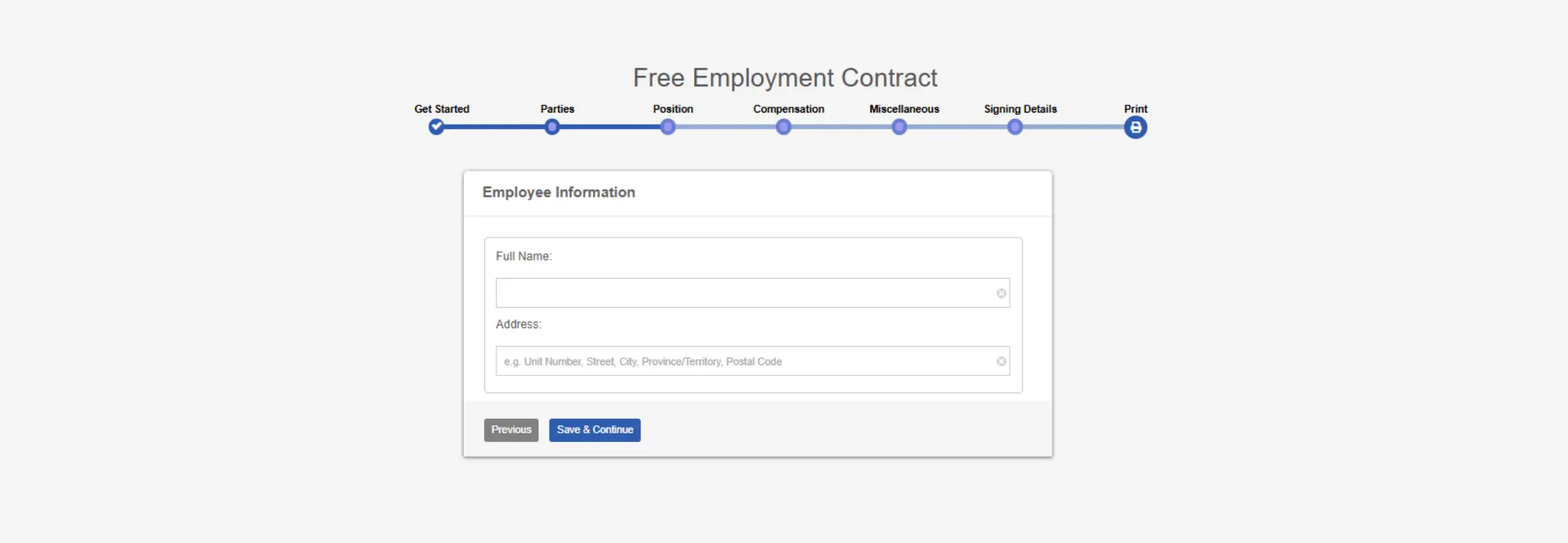
1. Select Employment Contract Template
2. Specify Information of Parties Involved
Identify the employer and the worker by providing their full legal names and current business or residential addresses to anchor the agreement.
3. Add Job Position, Work Location, and Work Schedule
Clearly define the specific title and daily duties along with the primary work site and expected hours to prevent future role ambiguity.
4. Enter Compensation Details
Detail the salary and wage structure along with any bonus eligibility and benefit entitlements to satisfy transparency rules and minimize payment disputes.
5. Preview and Download
Carefully review the drafted agreement for accuracy and legal compliance before downloading a finalized version that is ready for secure digital execution.
Platform Benefits
Ziji Legal Forms provides a comprehensive solution for Canadian businesses that need professional quality documentation without the high cost of traditional drafting. The platform is built on a foundation of current jurisprudence, helping employers avoid common pitfalls like the Waksdale trap and the lack of fresh consideration. By offering localized templates for every province, the system ensures that your agreement respects the unique minimum standards of the local Employment Standards Act.
The user friendly interface allows for deep customization of restrictive covenants, ensuring that your non solicitation and confidentiality clauses are narrow enough to be enforceable in court. This level of precision is difficult to achieve with generic templates but is a core feature of the Ziji experience. Using this service allows managers to focus on growing their business while knowing that their legal foundations are secure and compliant with modern standards.
Conclusion: Protect Your Business with Professional Contracts
A professionally drafted employment agreement is the most effective tool available for managing risk and ensuring operational clarity in the Canadian market. By avoiding generic templates and defining roles clearly, employers can protect their intellectual property and minimize the chance of expensive litigation. Investing in a compliant and properly executed contract today is the best way to safeguard the long term stability of your organization.
Employment Contract FAQs
1. What does an Employment Contract do?
An Employment Contract establishes the employee's duties, compensation, work schedule, and other terms of employment.
2. Who should use an Employment Contract?
Businesses hiring employees should use an Employment Contract to clearly define the employment relationship.
3. Is an employee the same as an independent contractor?
No. Employees are part of the employer's workforce, while independent contractors operate independently and are generally responsible for managing their own business.
4. Why is a probation period included in an Employment Contract?
A probation period allows the employer to assess the employee's performance and suitability before confirming ongoing employment.
5. Does an Employment Contract have to be in writing?
While verbal agreements may be recognized in some situations, a written Employment Contract provides greater clarity and legal protection.
6. Where can the Ziji Legal Forms Employment Contract be used?
The Ziji Legal Forms Employment Contract is available for use throughout the supported Canadian jurisdictions.
Author
Mandar Sonavane
|
Legal Content Writer at Ziji Legal Forms Inc.
Symbiosis International University
Mandar is a legal content writer specializing in the development of clear, practical, and easy-to-understand legal resources. With a strong focus on legal research, content creation, and plain-language writing, he works closely with our legal professionals to ensure that legal documents and educational materials are accurate, accessible, and user-friendly. At Ziji Legal Forms Inc., Mandar is responsible for researching legal topics, drafting and reviewing content, and helping transform complex legal concepts into straightforward guidance that empowers individuals and businesses to confidently navigate their legal needs.
Reviewed By
Histon Shek
|
General Counsel and Co-Founder at Ziji Legal Forms Inc.
University of Alberta
Histon Shek was called to the Alberta Bar in 2006. He holds a BA in Sociology and Philosophy and an LLB from the University of Alberta. As co-founder of Ziji Legal Forms Inc., he focuses on making legal documents accessible and affordable, overseeing legal integrity and content development.







 Canada
 United States